It is warm but a thin mist hangs over the countryside on this last day of March. The forecasters say it is partly composed of dust from the Sahara desert. Here is the view from Churchland Wood across the plough to the distant Fairlight ridge buttressing against the sea.
As an ecologist and biodiversity researcher and recorder, the author visits a wide range of rural and urban habitats mainly close to his home in Sedlescombe near Hastings, East Sussex, UK. The weblog covers the full spectrum of wildlife, from mammals to microbes. As well as details of encounters with England’s flora and fauna, information on where to see species of interest is often given.
Wednesday, March 31, 2021
Last day of March 2021
Saturday, March 20, 2021
Two new arrivals
In an obscure corner of the garden the light caught a small conifer maybe 5cm tall. An adventurous seedling that is probably a yew, but possibly something else. The leaves go all round the central stalk, though I expect this is just a characteristic of a seedling. In Bean's Trees and Shrubs it says of the mature plant "leaves spirally attached to the twigs, but by the twisting of the stalks brought more or less into two opposed ranks." This made me look more closely at the mature yews in the garden with their bipinnate branchlets unlike the newly found seedling.
Not far away from the conifer there is a mound, the remains of many bonfires. Tana grew potatoes on this last year and there is a fine selection of weeds each summer, well nourished by the chemicals in the ash. Wood ash is a variable substance but usually composed mainly of calcium carbonate. However, there is often around 4% potash and 1% phosphate plus various trace elements. But I digress, the find of the day was a solitary flower of coltsfoot (Tussilago farfara) growing on the side of the mound.
Coltsfoot flowers appear at this time of year before the large leaves (shaped vaguely like colt's feet) and they are not at all common in our immediate area, preferring heavy clay soils. I have never seen any in or near our garden. A piece of root might, I suppose, have been brought in from somewhere else, but that seems unlikely. As it is a native plant, arrival by seed would seem the most probable explanation.
An infusion of the leaves was once widely used as a remedy for coughs and, in some places, the dried leaves were used as a substitute for tobacco and smoking it was said to help asthma sufferers. The plant is also used to flavour coltsfoot rock made, over the last hundred years, to a secret recipe by Stockley's Sweets of Oswaldtwistle in Lancashire. The aniseed/liquorice flavour is said to be 'strangely addictive' and it appears to be quite popular still.
Thursday, March 18, 2021
Vole and daffodils
Tana put some scraps out on a log just outside our back door the other day and it was not long before they attracted the attention of a vole, a bank vole, Microtus glareolus, kindly identified by British mammal expert Dr Mark Hows (It is not easy to distinguish them from field voles, Myodes agrestis.) It was a very nervous animal but I was just able to take a snap of it through the rather smudgy glass of the kitchen window.
Saturday, March 13, 2021
A few flowers
Still a windy day but quite pleasant, though cool, in the sunshine. I noted several 'heralds of spring ' in flower today - lady's smock (below), alexanders and, above, early dog violets (Viola reichenbachiana). Tana saw some wood anemones while on a walk.
Thursday, March 11, 2021
March winds
There is some hopeful anticipation that the current boisterous weather will win the next storm name on the 2021 list - 'Evert' (a short form of the German name Eberhard most frequently used in Sweden and The Netherlands). Here the wind came in strong gusts overnight and during the following day, with heavy rain showers. Sitting down the garden in the middle of the day, I was surprised that I could hear many birds singing over the deep roaring of the wind, like treble voices over a bass choir.
Great masses of air boomed over the garden from the south west keeping the tops of the trees in Churchland Wood (which I can see from my window) in constant motion. Bright sunshine picks out much of the detail: there are fading hazel catkins, goat willow flowers and the magpie's nest in one of the rowan trees. The birds are nowhere to be seen and may be sheltering in their insecure looking twiggy retreat, or perhaps they have a foul weather hideaway somewhere nearby. Most mammals are hiding too but one grey squirrel went hopping over the roof of the hut.
The two tallest trees in the garden are a wild cherry grown from a fruit I found in Orlestone Forest many years ago and the silver birch in my Square Metre project, The uppermost branches of the cherry are permanently bent over to the north, pushed that way by successive storms I suspect, especially as the trunk does not seem to move in the wind.. The birch, on the other hand grows ramrod straight though it sways, often quite violently in the wind.
An unusual effect of the wind is the way the path to the wood is strewn with pink camellia petals as though for some Oriental festival. The petals are being blown down from a Camellia 'Garden Glory' which has been in bloom since early January and still has many more flowers to come.
Monday, March 08, 2021
The mouse and the cherry stones
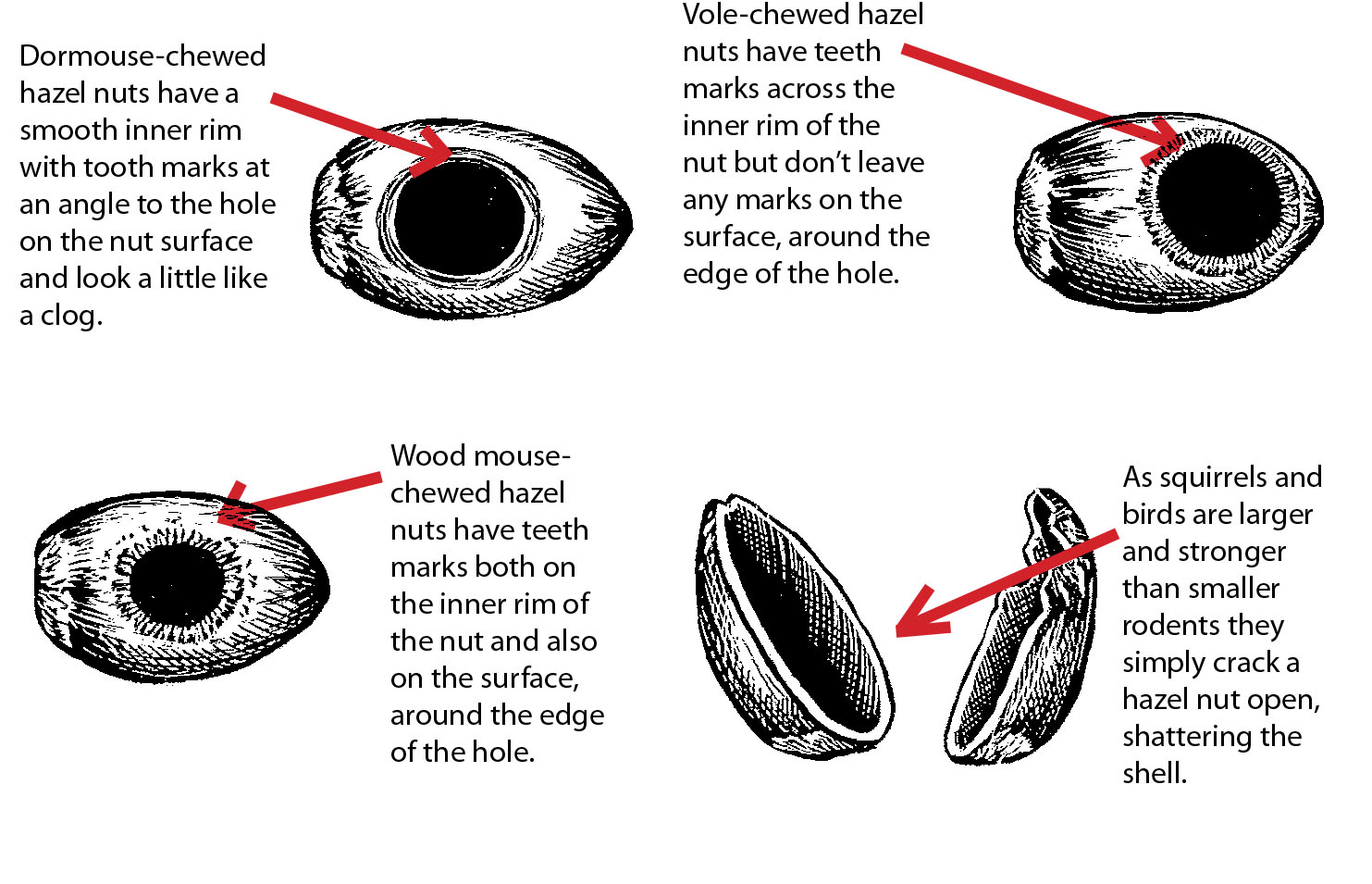
Underneath a large wild cherry tree (Prunus avium), in a small open area enclosed by protruding roots, I found a large horde of cherry stones. Each one had a hole chewed in the top. These holes had been made by a wood mouse, or mice, (Apodemus sylvaticus) to extract the kernel within. In summer the ground beneath this tree is strewn with fallen fruit and I wondered if the mice had collected these, maybe eaten the pulp, and then stored the cherry stones for later use. Though there were no stones that had not been opened, considerable effort must have been involved in making such a large midden, so maybe each one was brought from a store concealed nearby and dropped outside once its contents had been consumed.
Cherry stones have a reputation for toxicity as they contain amygdalin which converts to cyanide in the body if ingested. The amount of amygdalin in the kernels seems to vary considerable and there is a wide range of commentary on the Internet as to their relative danger to humans. One commentator claims that "A single cherry yields roughly 0.17 grams of lethal cyanide per gram of seed, so depending on the size of the kernel, ingesting just one or two freshly crushed pits can lead to death". Others recommend they are used to flavour cherry jam.
However, according to Adriano Chan et al., mice are more resistant to the effects of cyanide than humans (see https://tinyurl.com/2snymrvy) so it would appear that our wood mice have not been in danger of poisoning themselves.
Sunday, March 07, 2021
An episode on the Isle of Sheppey
In February and March 2021 I read The Sea View Has Me Again. Uwe Johnson in Sheerness, a large book (733 pages) by Patrick Wright that plaits the life of the eminent German writer Uwe Johnson with a description of the past and present of the Isle of Sheppey in general and Sheerness, one of its main towns, in particular.
Uwe Johnson was born in Kammin on the Baltic coast in German Pomerania, (now Kamien Pomorski and in Poland). The area has had a complex history having been fought over by Germans, Poles and Swedes. During World War II German rocket launchers were stationed on Chrząszczewska Island (formerly Insel Gristow) that lies immediately to the west of Kammin and to which it is connected by a bridge. After the war, most Germans left Kammin and were replaced by Poles. The Johnson family moved to Anklam in German West Pomerania and also close to the Baltic with its winding rivers, lagoons and seacoast. These estuarine, rather bleak landscapes and equally bleak histories are thought partly to have attracted Johnson to live in a house in Sheerness overlooking the Thames Estuary for the last ten years of his life.
Patrick Wright is an author, historian and Emeritus Professor of Literature, History and Politics at King’s College, London. Among other things, Wright’s book (which has been highly praised by many critics) describes the numerous eccentricities of the Isle of Sheppey and its people, many of which did, or would have, attracted the interest of Uwe Johnson. I would like to add a Sheppey episode of which Patrick Wright is unlikely to have heard but which, I think, may have amused Uwe Johnson.
In the early years of the current century I took up the study of mosses and joined the British Bryological Society (BBS). Shortly afterwards I learnt that the BBS were conducting a survey of the bryophytes (mosses, liverworts and hornworts) of arable fields. Most of these are in decline due to changes in agricultural practices. In order to improve records of their current distribution I was invited, in 2004, to join a November field meeting to look for as many of these species as we could find in stubble fields on the Isle of Sheppey. The fields chosen were to lie fallow all winter with the bryophytes therefore undisturbed (except by visiting bryologists).
Our small party of half a dozen enthusiasts gathered on a cold but bright day in a stubble field to the south of Eastchurch in an elevated position more or less in the centre of the island. It was cold with a wind from the north east. To find and study the various bryophytes that flourish in stubble fields requires searching on hands and knees, high powered magnifying glass in one hand and maybe a handbook and/or notebook in the other. It is cold and uncomfortable work and I wondered how many people from Eastchurch or elsewhere were troubled at the sight of full-grown men and women crawling across the windswept fields in prayerful attitudes, especially as we were quite close to one of Her Majesty’s Prisons.
The day was made more exciting by the arrival of a group of researchers from the University of Lancaster who were studying people who indulged in unusual pursuits and, clipboard in hand, a young woman asked questions and took notes about my interest in almost invisible ephemeral mosses despite weather and other seemingly negative circumstances.
One of the target species for the day was Bryum klinggraeffii which I had never heard of. Nevertheless one of our party called out that he had found some and I went and inspected the moss that bore such an interesting name. And there on the bare soil were a few small tufts of green between the rows of the prickly cut ends of summer corn. After a quick dissertation on the visible and distinctive features of the tiny leaves and stems of this diminutive plant he drew my attention to the small, reddish tubers hiding in the moss and which, because of their shape and colour, had won it the English name of ‘raspberry bryum’. These tubers, only about ¼ millimetre wide, often occur only on the moss’s rhizoids below ground and have to be searched for in loose soil (sometimes known as the ‘diaspore bank’).
The specific name for this moss was coined by W P S Schimper, an Alsatian botanist, who formally described the species in Hugo von Klinggräff’s 1858 book Die höheren Cryptogamen Preussens (The higher cryptogams of Prussia). Klinggräff was a 19th century German botanist who specialised in bryology. Both Uwe Johnson and Hugo Erich Meyer von Klinggräff were born in neighbouring provinces of Pomerania with Baltic coastlines, both in places where Germans have been replaced by Poles and German by Polish. I like to imagine that Klinggräff would be pleased that people were finding ‘his’ moss in fields on the island where his celebrated fellow Pomeranian had once chosen to live. Had they met I think they would have had much to talk about and I think Uwe Johnson might even have made an entry in one of his notebooks.
A small memorial of this day’s moss hunting in the bare, winter countryside on this estuary island can be found on the National Biodiversity Network’s web page for Bryum klinggraeffii. If one zooms in to Sheppey there is a small cluster of dots marking records of the species made in 2004 in the arable fields around Eastchurch.
Saturday, March 06, 2021
The old sallow tree in the middle of the garden died last summer and is now sporting a fine crop of Daedaleopsis confragosa the thin walled maze polypore or blushing bracket, the second name referring to the pores (botanically described as 'daedaloid') on the underside that 'blush' pinkish if they are pressed with a finger. The fungus is often found on willows and sallows (Salix spp.) but also occurs on many other trees where it causes white rot.
Friday, August 07, 2020
Enchanter's nighshade
Enchanter's nightshade (Circaea lutetiana) is once again flowering here and there in our garden and local woods. It is a small and modest plant with delicate pink and white flowers followed by small burrs, each containing a seed, which cling to one's trouser legs.
It appears to have very few virtues as an edible or medicinal plant but most people wonder how it came by its mysterious English name. This has been much discussed in various online places but generally it seems to have originated in the 16th and 17th century when many of the great European herbalists were writing about the medicinal and magical properties of plants. Among other things they explored the works of classical authors like Dioscorides (De materia medica, AD 50 -70). He wrote of a plant called 'kirkaia' in Greek which becomes 'Circaea' in Latin and can be translated as Circe's (plant). Quite what this was seems uncertain but enchanter's nightshade is one candidate.
The French name for Enchanter's nightshade was, at the time of the 16th and 17th C herbalists, 'circée' and this is still current in France, Italy and French-speaking Switzerland. The herbalists assumed this associated the plant with Circe, the enchantress of Homer's Odyssey who attracted Ulysses's men with her siren song then used a magic potion to turn them into pigs. The derivation of circée as a plant name may be correct but I have not seen any direct evidence that this was so. There are, however, some accounts of the plant being used by women to arouse men, though this may not pre-date the 16th century.
When the French herbalists were writing they often called Enchanter's nightshade 'circée de Paris'. This was not only because the plant grew commonly in the Paris area (and elsewhere in most of France) but to distinguish it from upland enchanter's nightshade (Circaea alpina) known in French as 'circée des Alpes'. Circée de Paris was written in Latin as 'circaea lutetiana', the second word deriving from 'lutetia' a Roman name for Paris, and Linnaeus used this when formally describing the plant in his Species Plantarum.
All that more or less explains the enchanter's part of the name, but why 'nightshade'? This is quite simply because the plant was thought to be a nightshade due to the shape of its leaves resembling woody nightshade (Solanum dulcamara). Gaspard Bauhin the 17th C Swiss botanist called it Solanifolia Circaea (nightshade-leaved circée) for example.
Sunday, May 17, 2020
Things on hornbeam leaves
Sunday, April 05, 2020
Two comfreys
The white, tubular flowers are very attractive to bumblebees and must be nectar rich. This picture was taken on 5th April and the plant had been in flower for well over a month, helping the bumbles to get off to a good start.
Most species of comfrey have had many medical applications in the past, but these are best avoided as plants in the Symphytum genus have been shown to be somewhat toxic.
We also have a colony of Hidcote comfrey, S. x hidcotense, with blue and white flowers but the same creeping habit. I think this must have been the plant Kenneth Grahame wrote about in Wind-in-the-Willows: "Comfrey, the purple hand-in-hand with the white, crept forth to take its place in the line."
Thursday, March 26, 2020
Onion loops
Sunday, December 29, 2019
Churchland
Plants (Plantae)
Flowering plants, conifers and ferns
In this flora of Churchland plants are arranged in alphabetical order in their groups by scientific name. I have included wild plants and the cultivated plants that can, in most instances, be seen from the roads or the footpaths. I will add to it from time to time but it will be ages (or never) before all the species that grow in Churchland are listed. All a bit like train spotting. Nomenclature follows Stace (2019). The New Flora of the British Isles, 4th edition.
Aquilegia vulgaris - Columbine. Occasional as a garden escape. Along 90 metre footpath TQ78371938, in gateway on Hurst Lane TQ78211943.
Arum italicum - Italian lords-and-ladies. There are two species of Arum in Churchland. This one and A. maculatum (see below). A. italicum with plain leaves (often knows as subspecies neglectum) is found wild in Britain only in the southern counties, usually near the coast.. Unlike A. maculatum the leaves emerge in autumn. There is also a variety with whitish veins in the leaves (often known as subspecies italicum). Plants with both plain and veined leaves occur here and there in Churchland, often originating as garden throw-outs. There is a patch outside Jessmond in Churchland Lane with both plain and veined leaves.
Anemone nemorosa - Wood anemone. Common in many woodlands, especially on clay soils.
Arum maculatum - Lords-and-ladies. Also known as cuckoo-pint and wild arum. Unlike the above the leaves appear in late winter or early spring and often have purple spots. It occurs in woods and hedgerows across the area.
Asplenium adiantum-nigrum - Black spleenwort
Athyrium filix-femina - Lady-fern
Asplenium scolopendrium - Hart's-tongue fern
Buxus sempervirens - Box. Widely planted in gardens for hedging and topiary.
Chrysosplenium oppositifolium - Opposite-leaved golden-saxifrage. Occasional in ditches and damp places.
Cupressus lawsoniana - Lawson's cypress
Cupressus x leylandii - Leyland cypress. Common as a hedgerow shrub and sometimes allowed to grow tall, e.g. by the car port at Woodstock in Churchland Lane. There is a variegated example with some creamy white shoots among the green in the hedge at Dino's in Churchland Lane close to the junction with Hurst Lane
Equisetum arvense - Field horsetail
Berberis - Barberries
Bergenia sp. - Elephant ears. One plant on the edge of Killingan Wood. Probably B. crassifolia from Siberia.
Blechnum spicant - Hard-fern
Calocedrus decurrens - Incense cedar
Caltha palustris - Marsh marigold. Scattered in the wild in Sedlescombe. Occurs in the pond in Tresco, Churchland Lane and the pond in Red Barn Field.
Chelidonium majus - Greater celandine. Has occurred as a casual in Churchland Lane.
Clematis vitalba - Traveller's joy, Old man's beard. Churchland Lane in the hedge where South View meets Little Oaks. There are many garden Clematis species, hybrids and varieties grown in the area.
.
Dryopteris affinis - Golden-scaled male-fern
Dryopteris carthusiana - Narrow buckler-fern
Dryopteris dilatata - Broad buckler-fern
Dryopteris filix-mas - Male-fern.
Ervilia hirsuta (formerly Vicia hirsuta) - Hairy tare. I have only seen this in the garden at South View where it is a persistent weed in flower-pots.
Ervum tetraspermum - Smooth Tare. Common in gardens and along hedgerow bottoms as well as in tough open ground.
Eschscholzia californica - Californian poppy. Widespread in gardens.
Ficaria verna - Lesser celandine (formerly Ranunculus ficaria). Common along waysides, hedgerows and field edges as well in more open parts of woodland where it can flower as early as mid-January. There are four subspecies recorded in Britain.
Griselinia littoralis - New Zealand broadleaf, New Zealand privet.or kapuka in Maori. An evergreen shrub often used for hedging, especially near the sea. There is a mature hedge of this species (with some beech mixed in) by Churchland Lane along the front fence of The Pantiles.
Helleborus argutifolius - Corsican hellebore. Only in gardens in Churchland.
Helleborus foetidus - Stinking hellebore. Cultivated in gardens but not recorded in the wild in Churchland.
Helleborus orientalis - Lenten-rose. Only in gardens in Churchland.
Hyacinthoides x massartiana. This is the 'Spanish bluebell' commonly encountered as an escape in and around gardens. It is a hybrid between the true Spanish bluebell, H. hispanica, and our native species. Distinguishing the Spanish bluebell from x massartiana needs care.
Hyacinthoides non-scripta, bluebell. A widespread and common species in most woodland in the area. Its scientific name has changed several times over the years and there is also much confusion with the Spanish bluebell with which it hybridises (see above). Stories are frequently published about the danger to our native bluebells from this hybridisation but this does not appear to be a threat in Churchland.
Hylotelephium telephium ssp. fabaria - Orpine. (Formerly Sedum telephium). Grown in gardens but also quite widespread in local woods and hedge banks. In Churchland it occurs in one place on the eastern bank of Hurst Lane.
Ilex x altaclerensis - Highclere holly. Frequent in gardens, usually as one of the variegated forms. A plant of the variety 'Golden King' (in fact a berry-bearing female plant) occurs in a hedge at Cherry Croft on the eastern side of Churchland Lane.
Ilex aquifolium - Holly
Juniperus communis - Common juniper
Larix decidua - European larch
Mahonia - Oregon grapes. Various species and varieties of Mahonia from North America are grown in Churchland gardens. Their yellow flowers in autumn, winter and spring provide important nectar and pollen for the bumble bees that fly in milder weather in the winter months.
Lotus corniculatus - Common bird's-foot-trefoil. Common in pastures and often on old lawns.
Lotus pedunculatus. Greater bird's-foot-trefoil. Common in longer vegetation and damper ground than L. corniculatus.
Myriophyllum aquaticum - Parrot's-feather. An aquatic plant from South America found in the wild in many ponds where it can suppress native plants. Pond at Tresco, Churchland Lane (needs checking).
Osmunda regalis - Royal fern
Paeonia officinalis - Garden peony. Several plants along Churchland Lane opposite Little Oaks gateway. Widely grown in gardens.
Papaver somniferum - Opium poppy. One plant occurred on a heap of brick rubble in the garden of Acorn Chalet in the early 21st century. It did not persist.
Petasites pyrenaicus - Winter heliotrope (formerly Petasites fragrans). A plant from the Mediterranean area with scented flowers in winter. Only the male plant is known in Britain but it spreads vegetatively and causes problems on roadside verges and elsewhere as its large, round leaves suppress smaller native plants. It is difficult to eradicate other than by using weedkillers. Occurs in various places in Churchland and usually flowers well at the point where Hurst Lane joins the A2244.
Picea abies - Norway spruce
Pinus sylvestris - Scots pine
Pittosporum tenuifolium. Known as kohuhu, black matipo and tawhiwhi in Maori, but there does not appear to be an English name apart from New Zealand pittosporum. There is a plant in the mixed hedge of Glendale in Churchland Lane. easily distinguished by the undulate margins of the bright green leaves.
Polystichum aculeatum - Hard shield-fern
Polypodium vulgare - Polypody fern
Polystichum setiferum - Soft shield-fern
Pteridium aquilinum - Bracken
Ranunculus acris - Meadow buttercup. Widespread in Churchland in open places.
Ranunculus auricomus - Goldilocks buttercup. Scattered in woodland in Churchland. This plant is apomictic and has a large number of agamospecies of which around 60 have been described but many more await description.
Ranunculus repens - Creeping buttercup. Common everywhere often in dam open places. A persistent weed in gardens.
Ribes nigrum - Black currant. One plant recorded from Killingan Wood. Widely grown in gardens
Ribes rubrum - Red currant. Frequent in woods and widely grown in gardens.
Ribes sanguineum - Flowering currant. One plant in Churchland Wood. Widely grown in gardens.
Ribes uva-crispa - Gooseberry. Recorded as a wild plant in Churchland Wood. Widely grown in gardens.
Sedum album - White stonecrop. A frequent escape from gardens on walls and gravelly paths. Sometimes used on green roofs.
Sempervivum tectorum - Houseleek. This and its varieties plus some other houseleek species are widely grown in Churchland gardens.
Symphoricarpos albus ssp. laevigatus - Snowberry. Introduced from western North America. The plant naturalised in Britain is ssp. laevigatus. There is a vigorous plant in a garden at TQ78351927 to the west of the footpath.
Symphytum grandiflorum - Creeping comfrey. Occurs in gardens and sometimes escapes. Can start to flower in January and is very attractive to bees.
Symphytum x hidcotense - Hidcote comfrey. Occurs in gardens.
Tellima grandiflora - Fringecups. From North America. Has sown itself for many years in the garden at South View in Churchland Lane.
Taxus baccata - Yew. Widely self-sown into local woodlands and frequently planted both as a free-standing tree and for a hedge, or topiary. There is an Irish yew, Taxus baccata 'fastigiata' by Churchland Lane on the boundary between South View and Little Oaks.
Viburnum tinus - Laurustinus. An introduced evergreen shrub from the Mediterranean area that has pink or white flowers in the colder months of the year. Itr is often ravaged by the viburnum leaf beetle beetle Pyrrhalta viburni. Laurustinus leaves have things called ‘domatia’ in some of the underside axils of some of the leaves. These domatia consist of clumps of small white hairs and act as shelter for a species of mite called Metaseiulus occidentalis. Apparently these mites eat the eggs of the red spider mite, Tetranychus urticae, which are very damaging to plants and laurustinus can therefore be of value to gardeners for control of this pest.
Viburnum x bodnantense. A group of hybrids between Viburnum farreri and V . grandiflorum. The first to be propagated was raised at Bodnant gardens in North Wales in 1935. The pink and white flowers appear on bare branches in midwinter and have a strong perfume. There is an example on the south west corner of The Pantiles' garden by Churchland Lane and also one in the garden of South View..
Vicia sativa ssp. nigra - Narrow-leaved vetch. Common in hedgerows and rough grassland.
Vicia sativa ssp. segetalis - Common vetch. Occasional in hedges and rough places.
Vicia sepium - Bush vetch. Common in hedgerows and rough places.
-
Friday, August 30, 2019
The Square Metre 19 July to 22 August 2019
In the top right hand corner the trunk of the mature birch tree growing in the original Square Metre can be seen
19 July 2019 Quite cool with rain approaching: its first intrusions could be felt in the wind. A muscid and an ichneumon sat each on its own rock in Cynthia’s Ridge, presumably enjoying the stored warmth. There was also a fragment of snail shell on one of the rocks indicating a thrush had been in action. Second Meadow Pond was half empty again. Many of the sorrel seedlings are marked with red to a greater or lesser degree.
A small hedge woundwort plant on the western edge of the Second Meadow has had most of its leaves eaten during the night.
Saturday, July 20, 2019
Highlights from June 2019
Thursday, July 18, 2019
The Square Metre, 13th June to 17th July 2019
16 June 2019 I photographed the sawfly leaf rolls spotted yesterday. One of the Epilobiums is in flower. I make it broad-leaved willowherb, Epilobium montanum but there are many hybrids of this species with close allies.
.
Something has eaten most of the western dandelion. One flower out on the small flowered sweet-briar. Dust bowl now quite wet after heavy rainstorms. The wood dock as been arched over by a clinging black bryony bine. Lammas shoots (somewhat early) are developing on the cordon oak.
.