Thursday, January 06, 2022

January, 2022

31 January 2022  The end of a cold, dry month though with few frosts, all of them light.  The lack of any significant rain for many days is, I think, affecting wildlife locally.  Hazel catkins seem slower to expand, I have seen no celandine flowers, fallen leaves remain on the woodland floor like a fluffy, dry eiderdown.  Still, there have been plenty of things to see and record.

We have several mahonias in the garden and these provide nectar rich flowers from November to February inclusive.  One of the most magnificent is Mahonia x media 'Buckland' which flowers right through December and January.
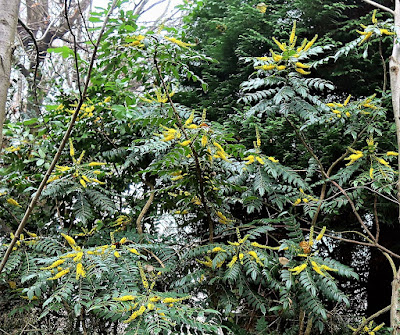

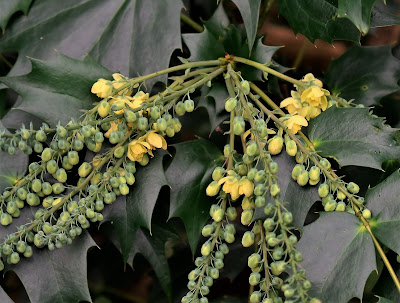
Rather more modest but still an attractive plant is Mahonia japonica which flowers here from late January through March.  It often attracts bumble and honey bees and blue tits raid the flowers for nectar, or I assume this is what they are finding.
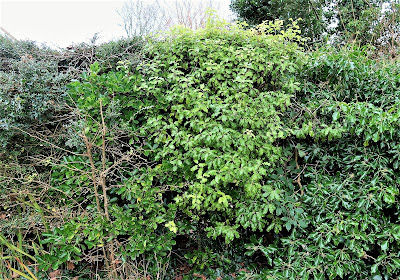
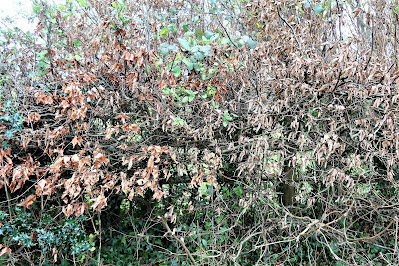
The hedges along the eastern side of Churchland Lane contain an extraordinary variety of plants and I am gradually trying to put a name to all of them, natives and non-natives alike.


The pale green mid-section of the hedge above and bordering Cherry Croft is Pittosporum tenuifolium, a New Zealand endemic but widely planted, particularly as a hedging shrub.  The darker green on the right is English ivy and, on the left, Euonymus japonica.


Another stretch of hedge a bit farther along shows how low cut, or young, beech and hornbeam retain their dead leaves in winter.  The warmer brown examples on the left are of beech and the greyer ones on the right of hornbeam.  

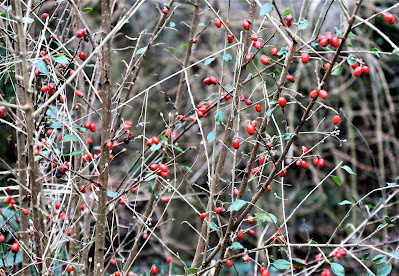
The self-sown cotoneaster behind our shed is still bearing a fine crop of berries (see below).  I think it is C. simonsii, the Himalayan cotoneaster.  'Himalayan' seems to vbe a bit of a misnomer as the native home of the species is the Khasi (or Khasia) Hills between Bhutan and Bangladesh in Assam, India.  The fruit are reputed to have a nasty taste which is said to be the cause of their remaining so long.  However, I am not at all certain the the taste buds of birds operate in the same way as ours.  My granddaughter and I sampled the brries and, while they were somewhat tasteless, they could not be described as unpleasant.


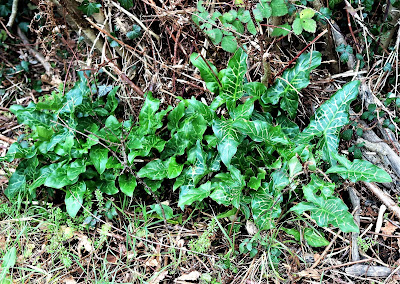
In a wander down the lane towards Saul-Hunt's I discovered a fine clump Italian lords-and-ladies, gigaro chiaro, Arum neglectum ssp. neglectum.  There are several places up the lane to the north and I expect this one has spread down from there.  I wrote much more about arums in this blog on 2 December 2017


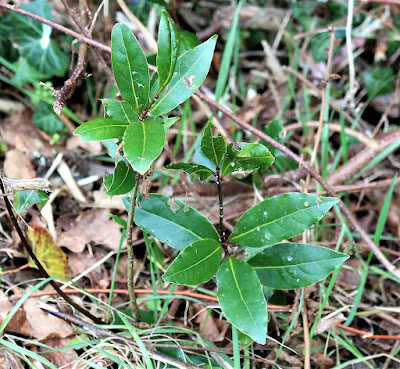
A bit further south I found a small, self-sown bay tree (Laurus nobilis)a species not common in the wild.  The leaves resemble laurustinus, which grows not far away, but the smell of the bay gives it away

In my survey of the hedges along Churchland Lane, I have had another go at the various 'false cypresses'.  On the east side of the lane along the boundary of Jesmond is a very solid length of  Leyland cypress, Cupressus × leylandii.  I found some small, empty cones on this which almost certainly indicates that this is the Leighton Green clone, C. x leylandii is a hybrid between the Nootka cypress (Cupressus nootkatensis) and the Monterey cypress (C. macrocarpa).  The name 'Leighton' is from Leighton Hall in Powys where the first Leyland cypress was raised.


I end this January's account with a photo of the seeds of old man's beard poised to provide splendid material for the soon to be constructed local bird's nests.


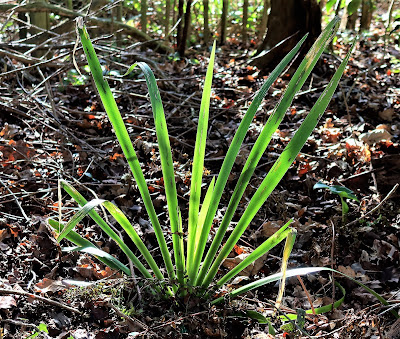
21 January 2022  While the earth, covered in dead autumn leaves, waits for the green sprinkles of spring, the leaves of stinking irises (or gladdons), Iris foetidissima, make lovely sunshot fans.  This is a plant that continues to increase locally.


Another plant that comes into its own in winter is a large variegated Persian ivy, Hedera colchica Dentata Variegata.  Here it has climbs high up an oak tree in our garden and makes a good winter shelter for small birds and, no doubt, various insects.

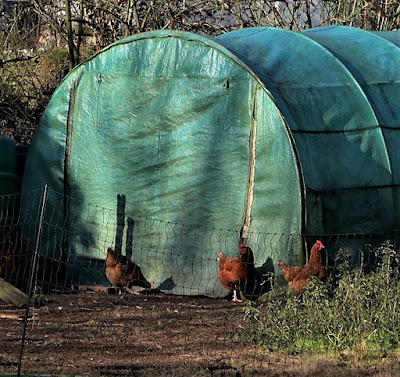
If I walk around the footpath that passes to the south of Saul-Hunt's paddock I often see their free range chickens, brown feathered bundles like animals in a child's farmyard.  Although we often don't treat them very well, they are endearing  creatures as they walk jerkily across their patch looking for seeds and insects.


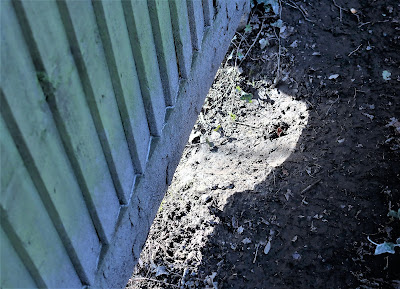
A little further on there is long overlap board fence.  The local badgers can't be bothered to go round this and have dug a hole under it.  Such animal runs are known as 'smeuses'.


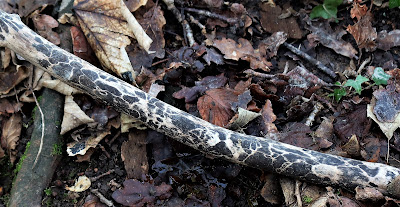
In winter natural patterns become more obvious as there is not so much to see.  I liked this debarked branch (below) with snake-like markings, perhaps trails of insects that lived under the bark when the branch was alive or recently fallen.


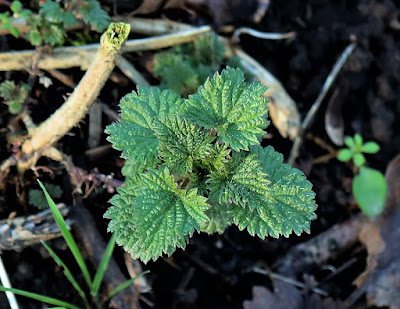
20 January 2022  A sequence of frosty nights and sunny days has slowed the onset of pre-spring.  In the lane new tufts of nettles are showing and it will soon be time for nettle soup, zuppa di ortiche.


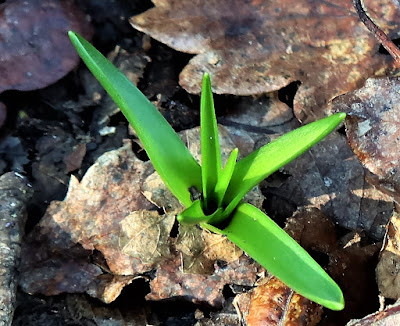
A few bluebell leaves poke through the ground ahead of the main flush and I wonder if they sare hybrids with Spanish bluebells or have some other genetic quirk.


In Killingan Wood I found what looks like a bush of Highclere holly, Ilex x altaclerensis.(see below). Some of the leaves look like the cultivar Cameliifolia as illustrated in Johnson & More, Collins Tree Guide, but in online picture the leaves of Cameliifolia are spineless, or almost spineless.  The Killingan Wood bush may be a hybrid between our native holly, I. aquifolium, and one of the Highclere cultivars of which there sre probably many in local gardens.


17 January 2022  Cold nights but sunny and cool days.  A badger has been digging for worms in the newly exposed stretch of verge alongside Churchland Lane
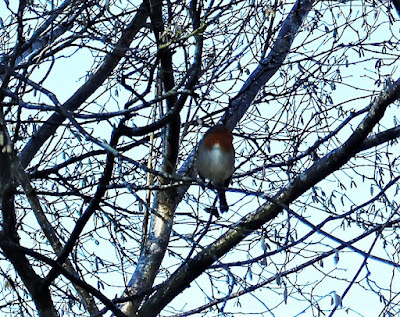

Birds are warming up for the breeding season.  The robin above was in full song in a hazel bush (with developing catkins in the background), a tawny owl was hooting in Churchland Wood and a great spotted woodpecker drumming in the trees along the stream on the western side of Churchland Fields.

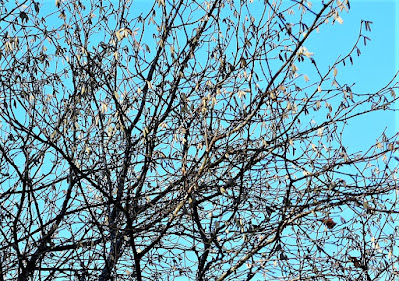
The hazel catkins in the picture above mostly are closed, though higher up the bush they are starting to open (see below), while on the opposite side of the lane, in another bush, they are fully open.
14 January 2022  
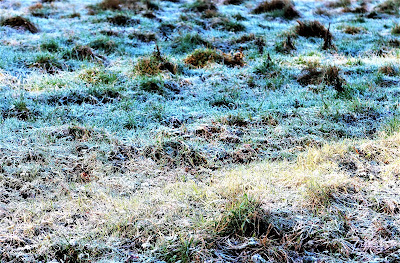
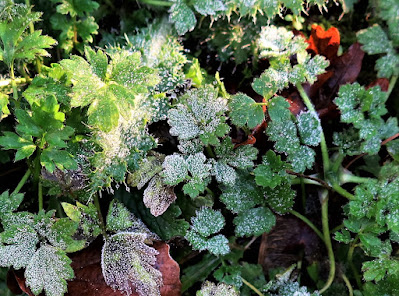
A sharp frost overnight whitened the grass in Churchland Fields and covered creeping buttercup leaves in my second Square Metre with Ice crystals like a scattering of sugar.
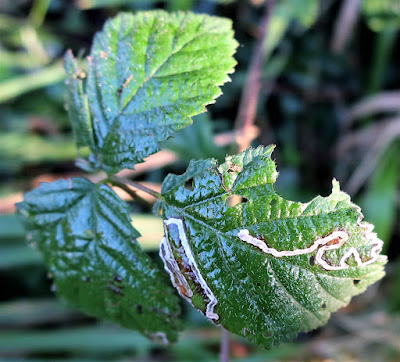
I noted two leaf mines in a frosted bramble leaf halfway down the garden.  I am pretty sure these have been made by the larvae of the tiny moth Stigmella aurella (there are some similar species that mine bramble leaves).  The larvae and pupae can survive frosts and, if occupied mines are brought indoors and kept in a jam jar, the moths like sooty, black sparklets will emerge often quite quickly.

I had a moment of delight when I found a single dandelion in full flower despite the hard weather.  As Wordsworth wrote:

To me the meanest flower that blows can give
Thoughts that do often lie too deep for tears.


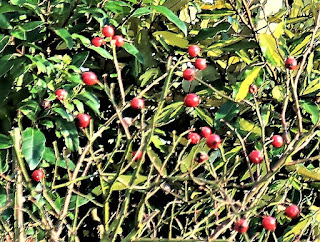
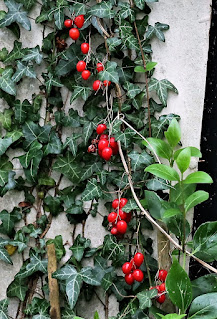
13 January 2022  I often wonder why some red berries are consumed by the birds much faster than others.  Those of rowans or hawthorns are stripped very quickly, for example, but black bryony and holly berries often stay in place well into the new year and there is a small bush in our lane of a rose cultivar covered in hips this mid-January (below).

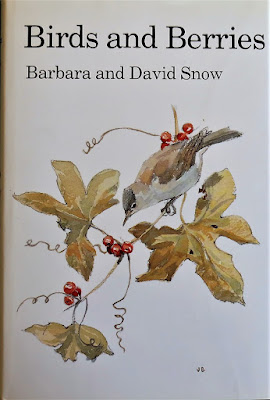
One of my favourite books Birds and Berries by Barbara and David Snow (T & A D Poyser, 1988) says that black bryony berries are eaten, usually after they have been on the vine for some time, by blackbirds and thrushes, though robins will occasionally tackle them though they are rather too large to swallow in one go.

Black bryony berries (below) are toxic to humans but perhaps simply rather unpalatable to birds.  The problems with humans and, presumably with other mammals, is that the berries (and root tubers) are full of calcium oxalate that forms tiny needle-sharp crystals that can penetrate skin and cell walls causing irritation which can be dangerous internally.

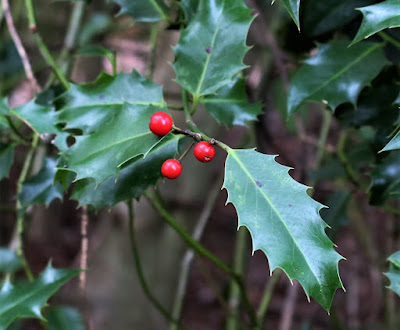
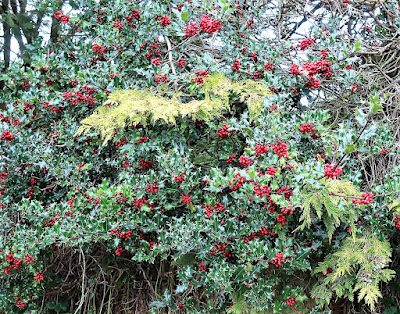
Two hollies in particular have caught my eye this autumn and winter .  One was an example, probably of garden origin, with an exceptionally rich crop of berries hanging over a fence in Broad Oak Brede (below).  

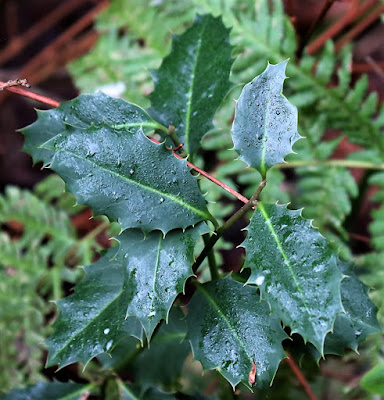
The other is a young plant on the fringe of my Square Metre project where it has been bird-sown from the overhanging medlar tree (see below).  It looks like a form of Highclere holly, Ilex x altaclerensis,  Judging by the shape and texture of the leaves and the prickles it is probably a hybrid between a garden form of Highclere holly and our native species, what is known as introgressive hybridisation.  The I. x altaclerensis of horticulture is a hybrid between Ilex perado (probably from Madeira) and our native species.  It is widely planted in gardens usually as a variegated clone with almost or completely spineless leaves. 

10 January 2022   
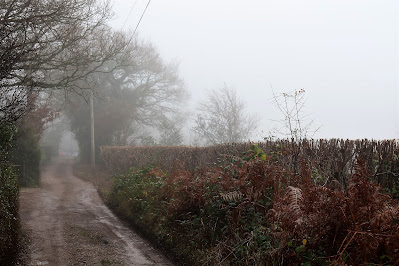

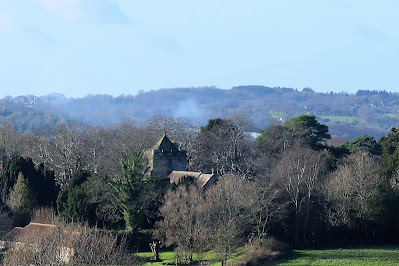
A lot of my 'ramblings' are now confined to Churchland Lane (above), the unadopted road to my house.  It is a cul-d-sac 833 metres long and it rises from 60 to 75 metres to the north of the East Sussex village of Sedlescombe.  There are good views to the west as far as the forest ridges to the north and south of Battle.  The horizon in picture below shows the highest part of Dallington Forest some 8km (5 miles) to the west of the lane with Sedlescombe parish church in the foreground.


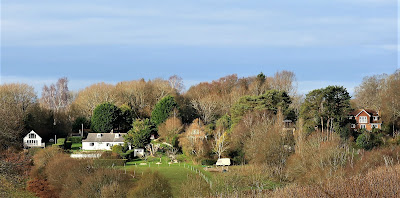
I also like the view, also to the west, across Churchland Fields to the bright buildings with their mix of evergreen and deciduous trees on Sandrock Hill.  They often catch the afternoon sun.

8 January 2022  Cold, hard rain all day and all night.  I didn't venture forth.  Instead I took this picture, blurred with rain, through the French windows out into the patch of garden I spend much of each day contemplating.  
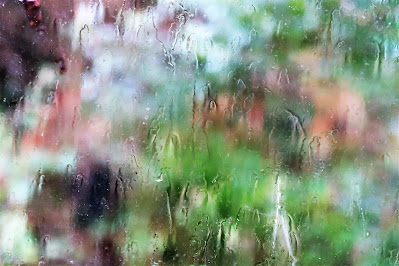

I wondered where the birds I usually see were sheltering.  The commonest species (I don't have bird feeders) are blackbirds, hedge sparrows, wrens, robins, thrushes, wood pigeons and magpies.  All the finches, except that occasional goldfinches and bullfinches, have disappeared and, of course, there are buzzards and things flying overhead that I cannot see. Indeed when the windows are covered with raindrops and my glasses are dirty I cannot see very much at all. It's cold indoors too.

6 January 2022  A sharp overnight frost leaving a white sheen over the lawn and silvered fallen leaves on the wooden ramp outside my window.

The terminal leaves of the spurge Euphorbia amygdaloides ssp. robbiae (Mrs Robb's bonnet) start to expand, in their bent over way, at this time of the year like narrow hop cones and contrasting with the old, darker green foliage.  In a few weeks they will have grown into flower heads. This is one of the earliest signs that things are starting to move towards spring.
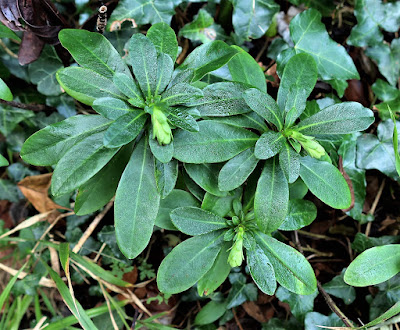

5 January 2022  A sunny, mild morning.  In the hedge on the eastern side of the lane I found a single plant of Berberis darwinii.  Though not very obvious, I was surprised at the number of times I must have walked past it without noticing it.

We have a very active thrush, perhaps a pair, in the garden that looks as though they will soon be starting to build a nest.

3 January 2022  A change of walking route took me right to the end of Churchland Lane (nearly half a kilometre from home). A few metres up Hurst Lane, in the front garden of Tresco, I stopped to look at the fragile blossoms on the winter flowering cherry, Prunus x subhirtella 'Autumnalis Rosea'.
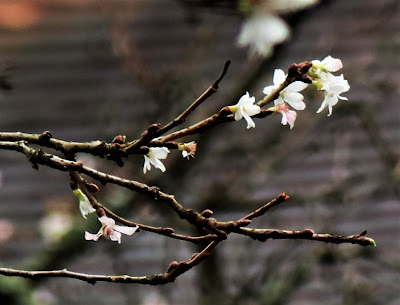

This cherry is a very long-lived species and there are some massive and very old specimens in Japan where it originated. There is, for example, an 1800 to 2000 year old  tree called the Jindai Zakura in the grounds of the  Jissō-ji temple in the community of Hokuto in Yamanashi prefecture. Some stones of this were taken into space by NASA and circled the earth for 8 months.  One of those which germinated produced flowers with six petals instead of five.

New Year’s Day, 1 January 2022

Must get more done this year.

On the western side of Churchland Lane there is a 30 metre stretch of verge that has been cleared right back to the hedge. This has left a 2 metre wide stretch of somewhat disturbed, dark and rich looking soil with a variety of low growing plants and the saw-shattered stumps of young trees and shrubs. A distinctive feature on New Year’s Day was the many shiny green tufts of emerging Arum maculatum, cuckoopint, leaves perhaps a hint that this newly uncovered section of this verge will reveal much of interest in coming months.

In the garden the pink, single camellia (Camellia × williamsii 'J.C. Williams') always the first, has started flowering. My late wife used to refer to this as "her camellia", though there were many more varieties in the garden. I assume it was because she could see it from the kitchen window.  The wintersweet (Chimonanthus praecox, là méi) in the flowerbed where the old shed used to stand is in full flower and casting its powerful scent on the air on milder days.  This year it has perhaps the best display I have seen but the blossoms turn to a dowdy speckled yellow if there is much frost (so far this winter we have had only one or two nights of light frost and today the temperature reached 14°C, very high for the time of year).
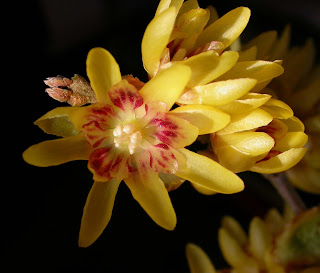

Wintersweet is found wild in China where it is also widely grown, both for its winter scent and various medicinal properties.  The flowers can be sprinkled into tea.

Killingan Wood was calm and damp, a silent army of grey trunked hornbeam trees, with a carpet of decaying fallen leaves braided by muddy tracks.

On my walk I saw very few insects. Over most of my life warm winter days like this have seen numerous small swarms of many insect species that are adapted to flying only in the winter months. But they seem to have gone. This will affect birds and spiders as well as the many small creatures that must have fed on their fallen bodies and earlier stages. The consequences for biodiversity are unknown.

Many writers reflect on the decline of the cuckoo, or the pearl bordered fritillary, but this morning I would like to pay homage to an absent friend: Gymnometriocnemus brumalis a winter flying, non-biting midge.

Maybe, if we have a cold spell, there will be a belated emergence, but I hope 2022 will not be the year when we have to say goodbye to this small winter flying insect.


Wednesday, March 31, 2021

Last day of March 2021

 It is warm but a thin mist hangs over the countryside on this last day of March.  The forecasters say it is partly composed of dust from the Sahara desert.  Here is the view from Churchland Wood across the plough to the distant Fairlight ridge buttressing against the sea.      


Birds are now very active nest building and, as I sit at my lap top, I can see the magpies coming and going from their nest in a rowan tree.  Sometimes the pair go and perch on top of the tallest tree in the garden, a wild cherry, from where they can get a 360 degree view.


Often the woodpigeons, who also nest in the garden, get there first.


We have a large area of lesser periwinkle (Vinca minor) under the hawthorns halfway down the garden.  This effective ground cover is currently sprinkled with flowers, but these seem to appear in much greater quantity around the edges of this periwinkle area. 


Saturday, March 20, 2021

Two new arrivals

 In an obscure corner of the garden the light caught a small conifer maybe 5cm tall.  An adventurous seedling that is probably a yew, but possibly something else. The leaves go all round the central stalk, though I expect this is just a characteristic of a seedling. In Bean's Trees and Shrubs it says of the mature plant "leaves spirally attached to the twigs, but by the twisting of the stalks brought more or less into two opposed ranks."  This made me look more closely at the mature yews in the garden with their bipinnate branchlets unlike the newly found seedling.

Not far away from the conifer there is a mound, the remains of many bonfires.  Tana grew potatoes on this last year and there is a fine selection of weeds each summer, well nourished by the chemicals in the ash.  Wood ash is a variable substance but usually composed mainly of calcium carbonate.  However, there is often around 4% potash and 1% phosphate plus various trace elements.  But I digress, the find of the day was a solitary flower of coltsfoot (Tussilago farfara) growing on the side of the mound.

Coltsfoot flowers appear at this time of year before the large leaves (shaped vaguely like colt's feet) and they are not at all common in our immediate area, preferring heavy clay soils.  I have never seen any in or near our garden.  A piece of root might, I suppose, have been brought in from somewhere else, but that seems unlikely.  As it is a native plant, arrival by seed would seem the most probable explanation. 

An infusion of the leaves was once widely used as a remedy for coughs and, in some places, the dried leaves were used as a substitute for tobacco and smoking it was said to help asthma sufferers.  The plant is also used to flavour coltsfoot rock made, over the last hundred years, to a secret recipe by Stockley's Sweets of Oswaldtwistle in Lancashire.  The aniseed/liquorice flavour is said to be 'strangely addictive' and it appears to be quite popular still.


Thursday, March 18, 2021

Vole and daffodils

Tana put some scraps out on a log just outside our back door the other day and it was not long before they attracted the attention of a vole, a bank vole, Microtus glareolus, kindly identified by British mammal expert Dr Mark Hows  (It is not easy to distinguish them from field voles, Myodes agrestis.) It was a very nervous animal but I was just able to take a snap of it through the rather smudgy glass of the kitchen window. 


On my trip down the garden I was pleased to see a trio of wild daffodils (Narcissus pseudonarcissus) in flower.  They have slightly drooping two-toned flowers and mine have now survived for many years with no attention. Those below had arranged themselves together like Three Little Maids from School.


Saturday, March 13, 2021

A few flowers


Still a windy day but quite pleasant, though cool, in the sunshine.  I noted several 'heralds of spring ' in flower today - lady's smock (below), alexanders and, above, early dog violets (Viola reichenbachiana).  Tana saw some wood anemones while on a walk.


Our colony of Tenby daffodils continues to look in good condition and, unlike other daffodils locally, have been unaffected by the recent gales.  The photo below shows that all the flowers face south.


Thursday, March 11, 2021

March winds

There is some hopeful anticipation that the current boisterous weather will win the next storm name on the 2021 list - 'Evert' (a short form of the German name Eberhard most frequently used in Sweden and The Netherlands).  Here the wind came in strong gusts overnight and during the following day, with heavy rain showers. Sitting down the garden in the middle of the day, I was surprised that I could hear many birds singing over the deep roaring of the wind, like treble voices over a bass choir.

Great masses of air boomed over the garden from the south west keeping the tops of the trees in Churchland Wood (which I can see from my window) in constant motion.  Bright sunshine picks out much of the detail: there are fading hazel catkins, goat willow flowers and the magpie's nest in one of the rowan trees.  The birds are nowhere to be seen and may be sheltering in their insecure looking twiggy retreat, or perhaps they have a foul weather hideaway somewhere nearby.  Most mammals are hiding too but one grey squirrel went hopping over the roof of the hut.

The two tallest trees in the garden are a wild cherry grown from a fruit I found in Orlestone Forest many years ago and the silver birch in my Square Metre project,  The uppermost branches of the cherry are permanently bent over to the north, pushed that way by successive storms I suspect, especially as the trunk does not seem to move in the wind..  The birch, on the other hand grows ramrod straight though it sways, often quite violently in the wind.


An unusual effect of the wind is the way the path to the wood is strewn with pink camellia petals as though for some Oriental festival.  The petals are being blown down from a Camellia 'Garden Glory' which has been in bloom since early January and still has many more flowers to come.

Monday, March 08, 2021

The mouse and the cherry stones

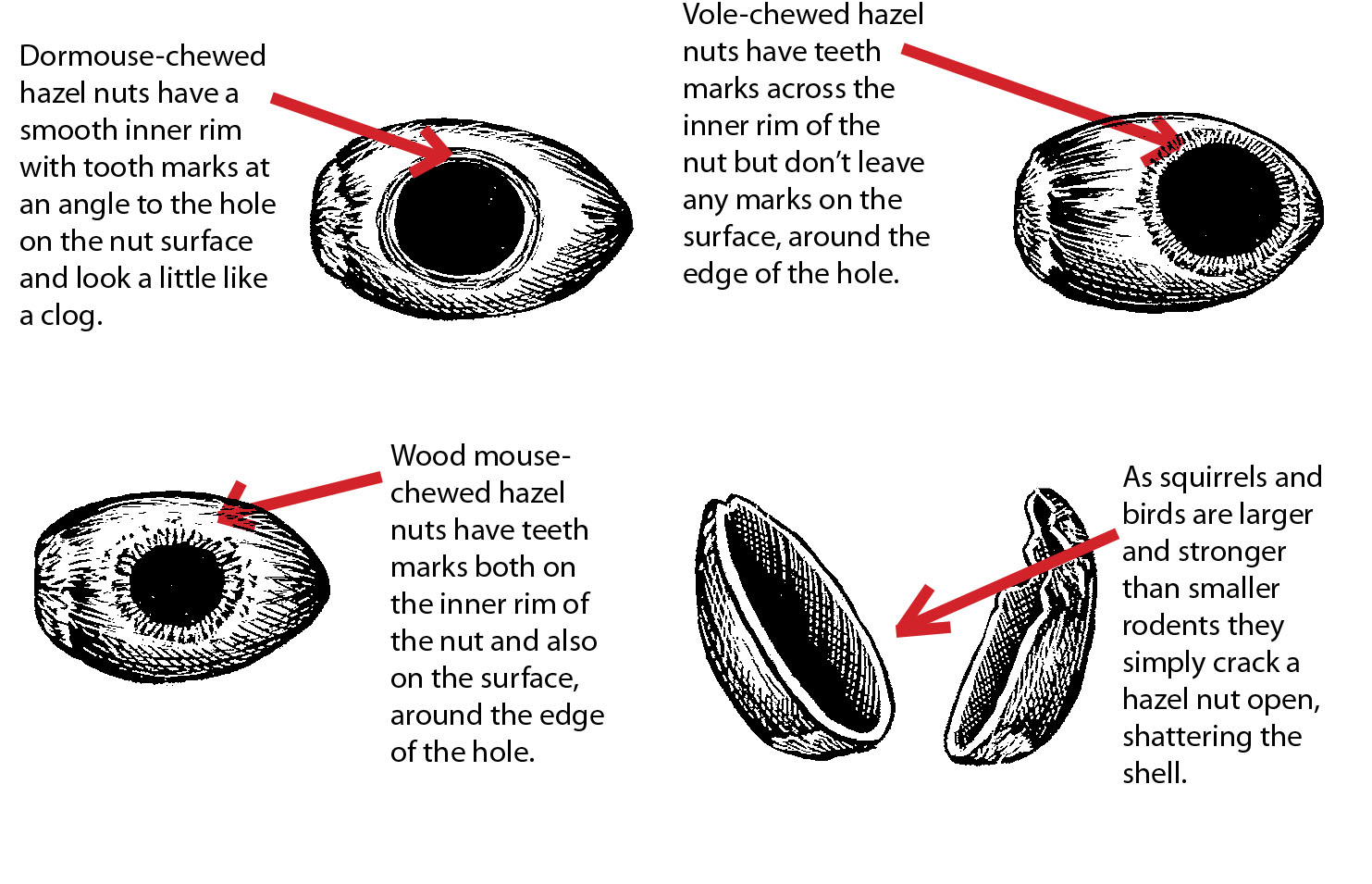
Underneath a large wild cherry tree (Prunus avium), in a small open area enclosed by protruding roots, I found a large horde of cherry stones.  Each one had a hole chewed in the top.  These holes had been made by a wood mouse, or mice, (Apodemus sylvaticus) to extract the kernel within.  In summer the ground beneath this tree is strewn with fallen fruit and I wondered if the mice had collected these, maybe eaten the pulp, and then stored the cherry stones for later use.  Though there were no stones that had not been opened, considerable effort must have been involved in making such a large midden, so maybe each one was brought from a store concealed nearby and dropped outside once its contents had been consumed.


As well as wood mice, cherry stones can be holed by dormice and voles although the markings made by the animals' teeth around the rim differ for each species.  There are a several illustrations of this online; a good one is at: https://ptes.org/wp-content/uploads/2014/07/chewed-nuts.jpg

Cherry stones have a reputation for toxicity as they contain amygdalin which converts to cyanide in the body if ingested.  The amount of amygdalin in the kernels seems to vary considerable and there is a wide range of commentary on the Internet as to their relative danger to humans.  One commentator claims that "A single cherry yields roughly 0.17 grams of lethal cyanide per gram of seed, so depending on the size of the kernel, ingesting just one or two freshly crushed pits can lead to death".  Others recommend they are used to flavour cherry jam.  

However, according to Adriano Chan et al., mice are more resistant to the effects of cyanide than humans (see https://tinyurl.com/2snymrvy) so it would appear that our wood mice have not been in danger of poisoning themselves.


Sunday, March 07, 2021

An episode on the Isle of Sheppey


In February and March 2021 I read The Sea View Has Me Again. Uwe Johnson in Sheerness, a large book (733 pages) by Patrick Wright that plaits the life of the eminent German writer Uwe Johnson with a description of the past and present of the Isle of Sheppey in general and Sheerness, one of its main towns, in particular.

Uwe Johnson was born in Kammin on the Baltic coast in German Pomerania, (now Kamien Pomorski and in Poland). The area has had a complex history having been fought over by Germans, Poles and Swedes. During World War II German rocket launchers were stationed on Chrząszczewska Island (formerly Insel Gristow) that lies immediately to the west of Kammin and to which it is connected by a bridge. After the war, most Germans left Kammin and were replaced by Poles. The Johnson family moved to Anklam in German West Pomerania and also close to the Baltic with its winding rivers, lagoons and seacoast. These estuarine, rather bleak landscapes and equally bleak histories are thought partly to have attracted Johnson to live in a house in Sheerness overlooking the Thames Estuary for the last ten years of his life.

Patrick Wright is an author, historian and Emeritus Professor of Literature, History and Politics at King’s College, London. Among other things, Wright’s book (which has been highly praised by many critics) describes the numerous eccentricities of the Isle of Sheppey and its people, many of which did, or would have, attracted the interest of Uwe Johnson. I would like to add a Sheppey episode of which Patrick Wright is unlikely to have heard but which, I think, may have amused Uwe Johnson.

In the early years of the current century I took up the study of mosses and joined the British Bryological Society (BBS). Shortly afterwards I learnt that the BBS were conducting a survey of the bryophytes (mosses, liverworts and hornworts) of arable fields. Most of these are in decline due to changes in agricultural practices. In order to improve records of their current distribution I was invited, in 2004, to join a November field meeting to look for as many of these species as we could find in stubble fields on the Isle of Sheppey. The fields chosen were to lie fallow all winter with the bryophytes therefore undisturbed (except by visiting bryologists).

Our small party of half a dozen enthusiasts gathered on a cold but bright day in a stubble field to the south of Eastchurch in an elevated position more or less in the centre of the island. It was cold with a wind from the north east. To find and study the various bryophytes that flourish in stubble fields requires searching on hands and knees, high powered magnifying glass in one hand and maybe a handbook and/or notebook in the other. It is cold and uncomfortable work and I wondered how many people from Eastchurch or elsewhere were troubled at the sight of full-grown men and women crawling across the windswept fields in prayerful attitudes, especially as we were quite close to one of Her Majesty’s Prisons.

The day was made more exciting by the arrival of a group of researchers from the University of Lancaster who were studying people who indulged in unusual pursuits and, clipboard in hand, a young woman asked questions and took notes about my interest in almost invisible ephemeral mosses despite weather and other seemingly negative circumstances.

One of the target species for the day was Bryum klinggraeffii which I had never heard of. Nevertheless one of our party called out that he had found some and I went and inspected the moss that bore such an interesting name. And there on the bare soil were a few small tufts of green between the rows of the prickly cut ends of summer corn. After a quick dissertation on the visible and distinctive features of the tiny leaves and stems of this diminutive plant he drew my attention to the small, reddish tubers hiding in the moss and which, because of their shape and colour, had won it the English name of ‘raspberry bryum’. These tubers, only about ¼ millimetre wide, often occur only on the moss’s rhizoids below ground and have to be searched for in loose soil (sometimes known as the ‘diaspore bank’).

The specific name for this moss was coined by W P S Schimper, an Alsatian botanist, who formally described the species in Hugo von Klinggräff’s 1858 book Die höheren Cryptogamen Preussens (The higher cryptogams of Prussia). Klinggräff was a 19th century German botanist who specialised in bryology. Both Uwe Johnson and Hugo Erich Meyer von Klinggräff were born in neighbouring provinces of Pomerania with Baltic coastlines, both in places where Germans have been replaced by Poles and German by Polish. I like to imagine that Klinggräff would be pleased that people were finding ‘his’ moss in fields on the island where his celebrated fellow Pomeranian had once chosen to live. Had they met I think they would have had much to talk about and I think Uwe Johnson might even have made an entry in one of his notebooks.

A small memorial of this day’s moss hunting in the bare, winter countryside on this estuary island can be found on the National Biodiversity Network’s web page for Bryum klinggraeffii. If one zooms in to Sheppey there is a small cluster of dots marking records of the species made in 2004 in the arable fields around Eastchurch.

Saturday, March 06, 2021

The old sallow tree in the middle of the garden died last summer and is now sporting a fine crop of Daedaleopsis confragosa the thin walled maze polypore or blushing bracket, the second name referring to  the pores (botanically described as 'daedaloid') on the underside that 'blush' pinkish if they are pressed with a finger.  The fungus is often found on willows and sallows (Salix spp.) but also occurs on many other trees where it causes white rot.


The fungus is named after Daedalus, a Greek architect and inventor who was commissioned by King Minos to build the labyrinth on the island of Crete.  Author James Joyce sometimes used the name Stephen Dedalus or Daedalus in an autobiographical sense perhaps referring, among other things, to the labyrinthine qualities of some of his writing.  'Confragosa, simply means 'rough' and refers to the upper sides of the brackets.


Friday, August 07, 2020

Enchanter's nighshade

Enchanter's nightshade (Circaea lutetiana) is once again flowering here and there in our garden and local woods.  It is a small and modest plant with delicate pink and white flowers followed by  small burrs, each containing a seed, which cling to one's trouser legs.

It appears to have very few virtues as an edible or medicinal plant but most people wonder how it came by its mysterious English name.  This has been much discussed in various online places but generally it seems to have originated in the 16th and 17th century when many of the great European herbalists were writing about the medicinal and magical properties of plants.  Among other things they explored the works of classical authors like Dioscorides (De materia medica, AD 50 -70).  He wrote of a plant called 'kirkaia' in Greek which becomes 'Circaea' in Latin and can be translated as Circe's (plant).  Quite what this was seems uncertain but enchanter's nightshade is one candidate.

The French name for Enchanter's nightshade was, at the time of the 16th and 17th C herbalists, 'circée' and this is still current in France, Italy and French-speaking Switzerland.  The herbalists assumed this associated the plant with Circe, the enchantress of Homer's Odyssey who attracted Ulysses's men with her siren song then used a magic potion to turn them into pigs.  The derivation of circée as a plant name may be correct but I have not seen any direct evidence that this was so.  There are, however, some accounts of the plant being used by women to arouse men, though this may not pre-date the 16th century.

When the French herbalists were writing they often called Enchanter's nightshade 'circée de Paris'.  This was not only because the plant grew commonly in the Paris area (and elsewhere in most of France) but to distinguish it from upland enchanter's nightshade (Circaea alpina) known in French as 'circée des Alpes'.  Circée de Paris was written in Latin as 'circaea lutetiana', the second word deriving from 'lutetia' a Roman name for Paris, and Linnaeus used this when formally describing the plant in his Species Plantarum.

All that more or less explains the enchanter's part of the name, but why 'nightshade'?  This is quite simply because the plant was thought to be a nightshade due to the shape of its leaves resembling woody nightshade (Solanum dulcamara).  Gaspard Bauhin the 17th C Swiss botanist  called it Solanifolia Circaea (nightshade-leaved circée) for example. 

Sunday, May 17, 2020

Things on hornbeam leaves

I seem to have been doing well with hornbeam leaves this year, especially as they do not normally seem to produce anything very exciting.  My first discovery was the tiny galls of the mite Aceria tenellus in the axils of veins in several leaves of the hornbeam cordon in my Square Metre, as well as on the edge of Killingan Wood up the lane.  There are only a few records of this species from Sussex and I expect it has been overlooked rather than being generally scarce.


My next discovery was of quite a few empty mines of the small purple hazel moth Paracrania chrysolepidella (it also feeds on hazel), an attractive, Nationally Notable class B, early flying micro.


While examining these I noticed a strange corkscrew  like gall on a leaf edge (see below) which turned out to be that of another mite, Aceria macrotrichus.  According to the National Biodiversity Network (NBN) there is only one British record of this (from the Midlands).  There were no Sussex records in the databases of the Sussex Biodiversity Record Centre.  As well as the corkscrew-like structure there are vermiform swellings along the veins in the underside of the leaf and slits on the upperside from which the mites can leave


The next day I was looking to see if there were any more of these galls.  There were not, but I found the considerable mass of eggs (see below) that some insect had laid on the underside of a hornbeam leaf.  After arrival at home they started to hatch into tiny caterpillars, so I have put them on the hornbeam cordon down the garden in my Square Metre project.


Sunday, April 05, 2020

Two comfreys

Part of our garden is carpeted with creeping comfrey, Symphytum grandiflorum.


The white, tubular flowers are very attractive to bumblebees and must be nectar rich.  This picture was taken on 5th April and the plant had been in flower for well over a month, helping the bumbles to get off to a good start.

Most species of comfrey have had many medical applications in the past, but these are best avoided as plants in the Symphytum genus have been shown to be somewhat toxic.

We also have a colony of Hidcote comfrey, S. x hidcotense, with blue and white flowers but the same creeping habit.  I think this must have been the plant Kenneth Grahame wrote about in Wind-in-the-Willows: "Comfrey, the purple hand-in-hand with the white, crept forth to take its place in the line."


Thursday, March 26, 2020

Onion loops

One of the most delicately beautiful phenomenon of this rising spring are these arching leaves of wild onion (Allium vineale).  It seems to me an uncommon shape in our British flora.  These are just outside my Square Metre project and I think they may produce heads of bulbils this year.  The first wild onions appeared under the medlar tree a short distance away many years ago where their bulbils were probably dropped by birds. They are slowly advancing eastwards towards the Square Metre itself but have never 'flowered'.


A relaxing half hour can be had by contemplating these onion loops and listening to John Adams Shaker Loops at the same time.

Sunday, December 29, 2019

Churchland

Churchland is roughly the area I can reach on foot from my home.  Further details will follow but my general intent is to make it a series of searchable notes on the small part of the High Weald lying to the north of Sedlescombe Street.  My house, South View, is close to the centre of a rough pentagon of tarmac roads at OS grid reference TQ782188.  It is on Churchland Lane which runs as a unmade road towards the village, then a footpath, then a made road through Balcombe Green and finally down to the main road through the village via Long Lane.  It more or less cuts the area I call Churchland in half while to the west there is a series of fields known generally as Churchland Fields and a wood to the east of our garden called Churchland Wood.

Plants (Plantae)

Flowering plants, conifers and ferns

In this flora of Churchland plants are arranged in alphabetical order in their groups by scientific name.  I have included wild plants and the cultivated plants that can, in most instances, be seen from the roads or the footpaths.  I will add to it from time to time but it will be ages (or never) before all the species that grow in Churchland are listed.  All a bit like train spotting.  Nomenclature follows Stace (2019).  The New Flora of the British Isles, 4th edition.

Aquilegia vulgaris - Columbine.  Occasional as a garden escape.  Along 90 metre footpath TQ78371938, in gateway on Hurst Lane TQ78211943.

Arum italicum - Italian lords-and-ladies.  There are two species of  Arum in Churchland.  This one and A. maculatum (see below).  A. italicum with plain leaves (often knows as subspecies neglectum) is found wild in Britain only in the southern counties, usually near the coast..  Unlike A. maculatum the leaves emerge in autumn.  There is also a variety with whitish veins in the leaves (often known as subspecies italicum).  Plants with both plain and veined leaves occur here and there in Churchland, often originating as garden throw-outs.  There is a patch outside Jessmond in Churchland Lane with both plain and veined leaves.

Anemone nemorosa - Wood anemone.  Common in many woodlands, especially on clay soils.

Arum maculatum - Lords-and-ladies.  Also known as cuckoo-pint and wild arum.  Unlike the above the leaves appear in late winter or early spring and often have purple spots.  It occurs in woods and hedgerows across the area.

Asplenium adiantum-nigrum - Black spleenwort

Athyrium filix-femina - Lady-fern

Asplenium scolopendrium - Hart's-tongue fern

Buxus sempervirens - Box.  Widely planted in gardens for hedging and topiary.

Chrysosplenium oppositifolium - Opposite-leaved golden-saxifrage.  Occasional in ditches and damp places.

Cupressus lawsoniana - Lawson's cypress

Cupressus x leylandii - Leyland cypress.  Common as a hedgerow shrub and sometimes allowed to grow tall, e.g. by the car port at Woodstock in Churchland Lane.  There is a variegated example with some creamy white shoots among the green in the hedge at Dino's in Churchland Lane close to the junction with Hurst Lane

Equisetum arvense - Field horsetail

Berberis - Barberries

Bergenia sp. - Elephant ears.  One plant on the edge of Killingan Wood.  Probably B. crassifolia from Siberia.

Blechnum spicant - Hard-fern

Calocedrus decurrens - Incense cedar

Caltha palustris - Marsh marigold.  Scattered in the wild in Sedlescombe.  Occurs in the pond in Tresco, Churchland Lane and the pond in Red Barn Field.

Chelidonium majus - Greater celandine.  Has occurred as a casual in Churchland Lane.

Clematis vitalba - Traveller's joy, Old man's beard.  Churchland Lane in the hedge where South View meets Little Oaks.  There are many garden Clematis species, hybrids and varieties grown in the area.
.
Dryopteris affinis - Golden-scaled male-fern

Dryopteris carthusiana - Narrow buckler-fern

Dryopteris dilatata - Broad buckler-fern

Dryopteris filix-mas - Male-fern.

Ervilia hirsuta (formerly Vicia hirsuta) - Hairy tare.  I have only seen this in the garden at South View where it is a persistent weed in flower-pots.

Ervum tetraspermum - Smooth Tare.  Common in gardens and along hedgerow bottoms as well as in tough open ground.

Eschscholzia californica - Californian poppy.  Widespread in gardens.

Ficaria verna - Lesser celandine (formerly Ranunculus ficaria).  Common along waysides, hedgerows and field edges as well in more open parts of woodland where it can flower as early as mid-January.  There are four subspecies recorded in Britain.

Griselinia littoralis - New Zealand broadleaf, New Zealand privet.or kapuka in Maori.  An evergreen shrub often used for hedging, especially near the sea.  There is a mature hedge of this species (with some beech mixed in) by Churchland Lane along the front fence of The Pantiles.

Helleborus argutifolius - Corsican hellebore.  Only in gardens in Churchland.

Helleborus foetidus - Stinking hellebore.  Cultivated in gardens but not recorded in the wild in Churchland.

Helleborus orientalis - Lenten-rose.  Only in gardens in Churchland.

Hyacinthoides x massartiana.  This is the 'Spanish bluebell' commonly encountered as an escape in and around gardens.  It is a hybrid between the true Spanish bluebell, H. hispanica, and our native species.  Distinguishing the Spanish bluebell from x massartiana needs care.

Hyacinthoides non-scripta, bluebell.  A widespread and common species in most woodland in the area.  Its scientific name has changed several times over the years and there is also much confusion with the Spanish bluebell with which it hybridises (see above). Stories are frequently published about the danger to our native bluebells from this hybridisation but this does not appear to be a threat in Churchland.

Hylotelephium telephium ssp. fabaria - Orpine.  (Formerly Sedum telephium).  Grown in gardens but also quite widespread in local woods and hedge banks.  In Churchland it occurs in one place on the eastern bank of Hurst Lane.

Ilex x altaclerensis - Highclere holly.  Frequent in gardens, usually as one of the variegated forms.  A plant of the variety 'Golden King' (in fact a berry-bearing female plant) occurs in a hedge at Cherry Croft on the eastern side of Churchland Lane.

Ilex aquifolium - Holly 

Juniperus communis - Common juniper

Larix decidua - European larch

Mahonia - Oregon grapes.  Various species and varieties of Mahonia from North America are grown in Churchland gardens.  Their yellow flowers in autumn, winter and spring provide important nectar and pollen for the bumble bees that fly in milder weather in the winter months.

Lotus corniculatus - Common bird's-foot-trefoil.  Common in pastures and often on old lawns.

Lotus pedunculatus. Greater bird's-foot-trefoil.  Common in longer vegetation and damper ground than L. corniculatus.

Myriophyllum aquaticum - Parrot's-feather.  An aquatic plant from South America found in the wild in many ponds where it can suppress native plants.  Pond at Tresco, Churchland Lane (needs checking).

Osmunda regalis - Royal fern

Paeonia officinalis - Garden peony.  Several plants along Churchland Lane opposite Little Oaks gateway.  Widely grown in gardens.

Papaver somniferum - Opium poppy.  One plant occurred on a heap of brick rubble in the garden of Acorn Chalet in the early 21st century.  It did not persist.

Petasites pyrenaicus - Winter heliotrope (formerly Petasites fragrans).  A plant from the Mediterranean area with scented flowers in winter.  Only the male plant is known in Britain but it spreads vegetatively and causes problems on roadside verges and elsewhere as its large, round leaves suppress smaller native plants.  It is difficult to eradicate other than by using weedkillers.  Occurs in various places in Churchland and usually flowers well at the point where Hurst Lane joins the A2244.

Picea abies - Norway spruce

Pinus sylvestris - Scots pine

Pittosporum tenuifolium. Known as kohuhu, black matipo and tawhiwhi in Maori, but there does not appear to be an English name apart from New Zealand pittosporum.  There is a plant in the mixed hedge of Glendale in Churchland Lane. easily distinguished by the undulate margins of the bright green leaves.

Polystichum aculeatum - Hard shield-fern 

Polypodium vulgare - Polypody fern

Polystichum setiferum - Soft shield-fern

Pteridium aquilinum - Bracken

Ranunculus acris - Meadow buttercup.  Widespread in Churchland in open places.

Ranunculus auricomus - Goldilocks buttercup.  Scattered in woodland in Churchland.  This plant is apomictic and has a large number of agamospecies of which around 60 have been described but many more await description.

Ranunculus repens - Creeping buttercup.  Common everywhere often in dam open places.  A persistent weed in gardens.

Ribes nigrum - Black currant.  One plant recorded from Killingan Wood.  Widely grown in gardens

Ribes rubrum - Red currant.  Frequent in woods and widely grown in gardens.

Ribes sanguineum - Flowering currant.  One plant in Churchland Wood.  Widely grown in gardens.

Ribes uva-crispa - Gooseberry.  Recorded as a wild plant in Churchland Wood.  Widely grown in gardens.

Sedum album - White stonecrop.  A frequent escape from gardens on walls and gravelly paths.  Sometimes used on green roofs.

Sempervivum tectorum - Houseleek.  This and its varieties plus some other houseleek species are widely grown in Churchland gardens.

Symphoricarpos albus ssp. laevigatus - Snowberry.  Introduced from western North America.  The plant naturalised in Britain is ssp. laevigatus.  There is a vigorous plant in a garden at TQ78351927 to the west of the footpath.

Symphytum grandiflorum - Creeping comfrey.  Occurs in gardens and sometimes escapes.  Can start to flower in January and is very attractive to bees.

Symphytum x hidcotense - Hidcote comfrey.  Occurs in gardens.

Tellima grandiflora - Fringecups.  From North America.  Has sown itself for many years in the garden at South View in Churchland Lane.

Taxus baccata - Yew.  Widely self-sown into local woodlands and frequently planted both as a free-standing tree and for a hedge, or topiary.  There is an Irish yew, Taxus baccata 'fastigiata' by Churchland Lane on the boundary between South View and Little Oaks.

Viburnum tinus - Laurustinus.  An introduced evergreen shrub from the Mediterranean area that has pink or white flowers in the colder months of the year.  Itr is often ravaged by the viburnum leaf beetle beetle Pyrrhalta viburni. Laurustinus leaves have things called ‘domatia’ in some of the underside axils of some of the leaves.  These domatia consist of clumps of small white hairs and act as shelter for a species of mite called Metaseiulus occidentalis.  Apparently these mites eat the eggs of the red spider mite, Tetranychus urticae, which are very damaging to plants and laurustinus can therefore be of value to gardeners for control of this pest.

Viburnum x bodnantense.  A group of hybrids between Viburnum farreri and V . grandiflorum.  The first to be propagated was raised at Bodnant gardens in North Wales in 1935.  The pink and white flowers appear on bare branches in midwinter and have a strong perfume.  There is an example on the south west corner of The Pantiles' garden by Churchland Lane and also one in the garden of South View..

Vicia sativa ssp. nigra - Narrow-leaved vetch.  Common in hedgerows and rough grassland.

Vicia sativa ssp. segetalis - Common vetch.  Occasional in hedges and rough places.

Vicia sepium - Bush vetch. Common in hedgerows and rough places.
-