Friday, October 06, 2006

Hornbeam fusion


I came across this wonderful tree (or trees) in Brede recently. It is a hornbeam, Carpinus betulus, once part of a hedging operation, maybe in the 19th century. Perhaps four shoots came up from the horizontal and survived survived to make today's silvery trunks.

The tree reminded me of Rodin's famous sculpture of the Burghers of Calais (plenty of pictures of that on the Web).

Thursday, October 05, 2006

The overgrown pond


Just east of the busy A28, in the corner of a pasture at the end of a hedge, an old pond dreams of its youth when it was home to frogs and newts, when the cattle drank among the yellow flags cooling their feet in the marginal mud.

Now the water is gone, the willows are dead or dying and the marsh is turning to woodland. In the evening I sheltered here from the rain, watching a double rainbow arching over the hills towards Udimore and little squadrons of small craneflies gyrating in the last of the sunlight.

Wednesday, October 04, 2006

The great chequer tree collapses


The huge wild service tree, Sorbus torminalis, in Udimore, East Sussex, thought to be the largest in Britain, has collapsed still further and most of its branches lie spreadeagled on the ground.

As with many trees, it has produced a bumper final crop of fruit on the surviving parts to the left of the top picture. But is it final? I think parts of it may survive for a while and the roots may even send up some suckers protected from grazing within the wreckage of the mother tree.

I first saw this particular tree as a picture in a book published in 1945 - it was large then - and it has been on television three times over the last thirty years. Hopefully it will star one more time before its last leaves are shed.

Tuesday, October 03, 2006

Larva of The Festoon, Apodia limacodes


The recent winds have blown some interesting caterpillars out of our local trees. Today one of the grandchildren brought in the one in the picture above, a Festoon Moth, Apodia limacodes - they always have this peculiar woodlouse shape.

Although this species is reasonably widespread in South East England, this is the first caterpillar I have seen. Sometimes known as Apodia avellana is on oak feeder associated with ancient woodland. It is a BAP species categorised as 'nationally scarce'(Notable/Nb) and one of only two British members of the family Limacodidae (the other is The Triangle, Heterogenea asella).

Saturday, September 09, 2006

Three's a crowd


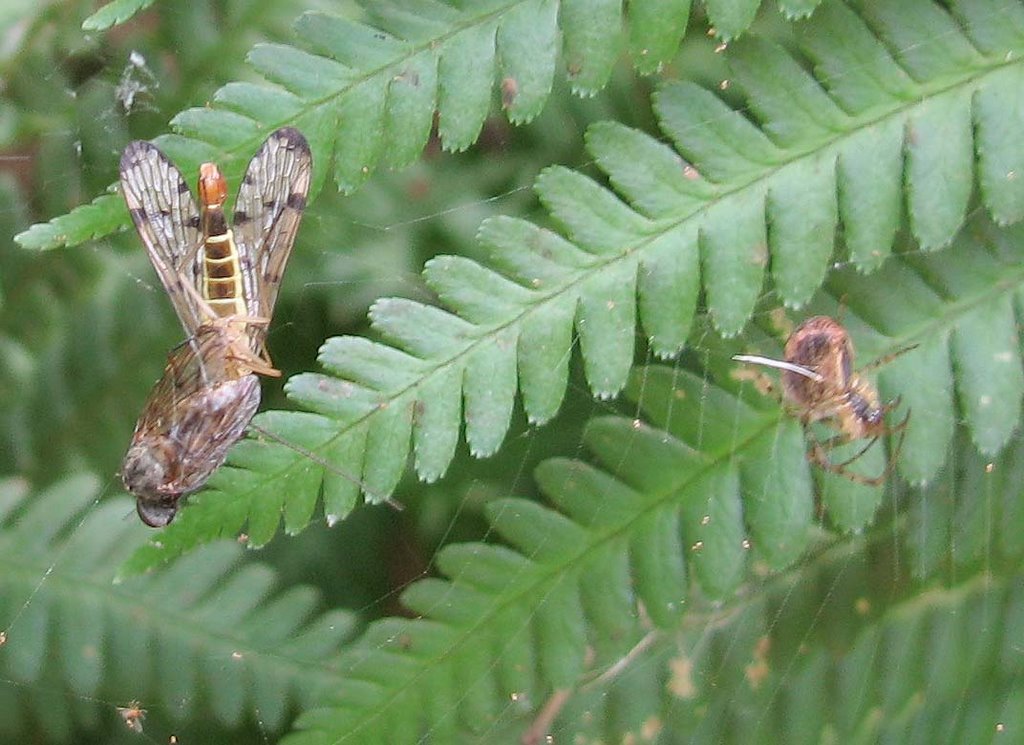
It looks here as though the spider on the right caught the fly and wrapped it up before being pushed to one side of the web by the scorpion fly with the orange tail who is enjoying a free lunch.

A small drama in our East Sussex garden.

Saturday, August 19, 2006

Horned leaf hopper, Ledra aurita


On a visit to the Sussex Wildlife Trust's offices in Henfield, I was shown an unmistakable horned leaf hopper, Ledra aurita, that one of the members had brought in for identification.

One of the largest British Homoptera, these insects are so well-camouflaged on the tree trunks and branches where they are normally found that they are seldom seen, though maybe they are quite common. In our area I think I have only come across them twice in the last 35 years.

Wednesday, August 09, 2006

More flowers in more meadows


Once again I have taken a walk around the meadows in the Marline Valley west of Hastings and been surprised by the colourfulness of the flowers. In places there is a purple haze of knapweed, Centaurea nigra: elsewhere yellow fleabane, Pulicaria dysenterica, mingles with pink marsh woundwort, Stachys palustris or bluish mauve water mint, Mentha aquatica.

I was struck by the fact that fleabane seems to comprise about 50% of some of these colourful patches and there are very few other plants involved. What prevents a monoculture from developing and why are the two major constituent plants so evenly mixed?

Another dimension is the smell. Walking through meadows like this delivers a complex, constantly changing olfactory experience quite lost in modern grass fields. And of course, there are the proverbial clouds of butterflies and bees all enjoying the experience too and adding sound as well as movement. A meadow for all senses.

Friday, July 28, 2006

Black-encrusted beech bark

Black beech trunk
Black beech trunk
I have led a number of walks through Flatropers Wood reserve near Rye in East Sussex recently and several people have asked why the bark of one beech tree in a plantation of many trees is covered practically all over with a black, lichen-like encrustation and, indeed, what it is.

If it isn't a lichen, and I tend to think it isn't, I wondered if it might be some sort of alga or fungus. But whether alga or not, why does it only grow on one of the trees? The tree, by the way, is very much alive and appears to be in perfect health and the black encrustation is wholly superficial and quite easy to rub off.

Note: A week or so after publishing this I concluded that the black encrustation was the microfungus Ascodichaena rugosa.

Tuesday, July 18, 2006

Bay sucker gall, Trioza alacris


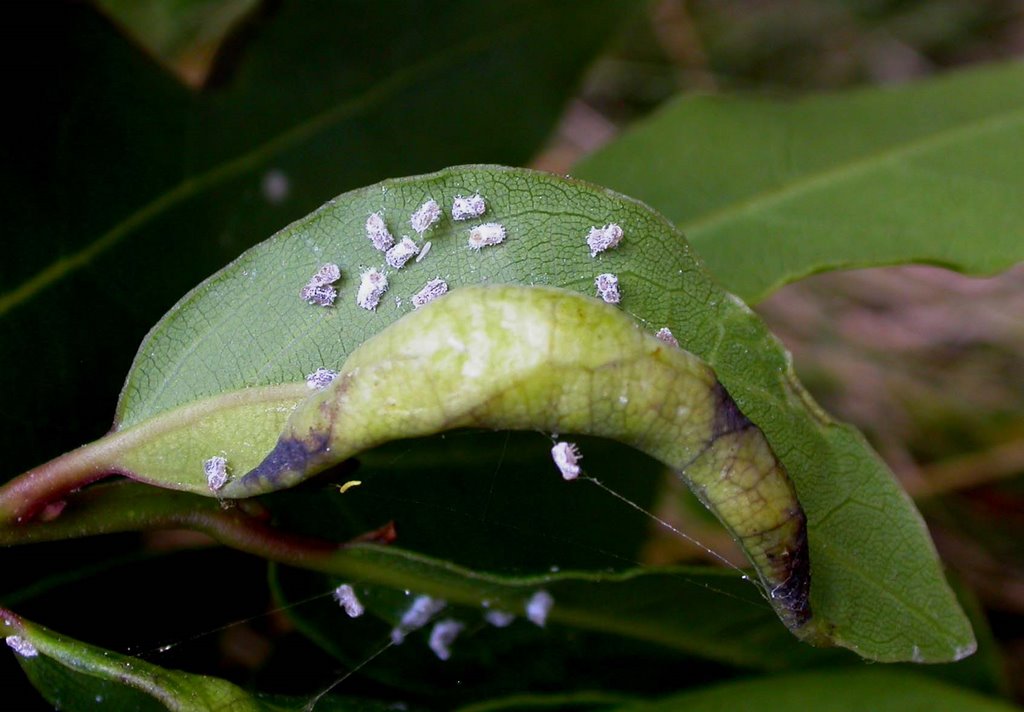
I found in Bexhill that the leaves of many bay trees, Laurus nobilis, were heavily infested with galls of the Psyllid plant hopper Trioza alacris.

I have often seen these galls on the bay trees that are, or used to be, so popular in suburban areas, but this is the first time I have seen the nymphs of the little creatures that cause them. They are covered with a grey, waxy material and a fluffy white extrusion.

This is an introduced species (as of course are bay trees) that has been spreading northwards in Britain.

Monday, July 17, 2006

Ringlet butterflies in 2006


The ringlet butterfly, Aphantopus hyperantus, seems to be having a particularly good year here in East Sussex. I have seen it quite commonly in five or six different places.

The one in the photo was in the Brede Valley part of our village of Sedlescombe and it is a butterfly that prefers damper grassland.

Part of the reason why butterflies often have eyes on their wings is so that predators will attck these rather than the head proper. The photo shows that this works as the butterfly has lost a chunk out of its wings where the 'eyes' are situated.

Sunday, July 16, 2006

Silver-washed Fritillaries & White Admirals

This year, 2006,is proving a very good one for some of our woodland butterflies such as the silver-washed fritillary, Argynnis paphia (above) and the white admiral, Limenitis camilla.

Both species are quite abundant in Bixley and the adjacent Flatropers Wood (see here) in Beckley and in Pond Wood, part of the Brede High Wood complex (see here).

Hopefully they will spread even further over the next few years. Part of the reason for their success is, I believe, that they are powerful fliers and can recolonise new areas fairly easily whereas the spring fritillaries, wood whites and other butterflies with less powerful flight are continuing to decline.

Friday, July 07, 2006

A Whatlington meadow


Yesterday I walked from the small village of Whatlington in East Sussex along the footpath that follows the tiny river Line to the east. About half a mile from the village there is the most astonishingly splendid wet meadow, though fairly dry after the recent summer heats. There is such a riot of colour here that it looks more like a large herbaceous border than a field. The purple loosestrife, Lythrum salicaria, is magnificently abundant and there are masses of perennial sow-thistles, meadow vetchling, hogweed and other summer flowers with plenty of bird and insect life.

This field is really unclassifiable and I have never seen anywhere quite like it. I suspect it has simply been abandoned in the sense that it is no longer grazed or cut (apart from the path) and the rising scrub indicates that it will be woodland in a few years time unless managed as rough grass. Like the bomb sites in post World War II London, transitional habitats often have an astonishingly rich biodiversity, but only for a short while. In the case of the Line valley (and many other places) it would be good if areas could be allowed to get to closed canopy woodland, then cleared back, even ploughed, so that the whole process of succession could start again. The different habitat phases would not be in the same places for long but, over a given area, there would always be some areas at the bare earth stage and some at the closed canopy stage and everything in between.

This field is at TQ766180 and there is full public access via the footpath. Parking is not easy in Whatlington village, but there is a small lay-by on the main road by the church. Follow the river bank eastwards from the village hall and cross left over the first bridge you come to, then turn right and follow the path to the meadow. A bonus before you reach the meadow is the quantities of beautiful demoiselle damselflies flitting about the brambles. If you feel like it you can walk right through to the A21, but I could stop in a meadow such as the one described for ever.

Friday, June 30, 2006

Brown argus, Aricia agestis, in Hastings


I recently saw a brown argus butterfly in another visit to the Marline Valley meadows, an SSSI on the western outskirts of Hastings. These butterflies are markedly smaller than the common blues that they fly alongside and the males as well as the females are brown.

Although quite common in places on the chalk, this butterfly seems to be rarely seen elsewhere in Sussex and, where it does occur, it is usually on, or near, the coast. The main foodplant of the caterpillars is rock-rose, Helianthemum chamaecistus, but this does not occur in Sussex away from the chalk, so the Marline larvae are probably eating the alternatives of stork's-bill or dove's-foot cranesbill.

The butterfly was recorded from Marline Meadows in 1989 and it is good to know that a colony is still there. As Jeremy Thomas says in his Butterflies of Britain & Ireland populations away from chalk, limestone or dunes are "invariably small and very rare."

The first generation adults are probably over by now, but there should be a larger second generation from late July to early September.

Saturday, June 24, 2006

Lesser stag beetle, Dorcus parallelipipedus


The female lesser stag beetle shown above appeared in our bedroom the other night (the smaller mandibles and two bumps on the forehead distinguish it from the male). I think it probably exited from a log of dead birch wood I had brought home earlier in the day as this species spends its early stages in such habitats.

The lesser stag beetle turns up from time to time in our part of East Sussex but there are no authenticated records of Lucanus cervus, the stag beetle proper. This is a bit of a mystery as this is a heavily wooded area with plenty of suitable habitat and the species seems common enough in surrounding areas. I often thinks that gaps of this kind occur because, at some time in the past, the species has been locally wiped out by a predator, parasite or disease. Sometimes, of course, they come back again, like the hornet that appeared widely in East Sussex (or reappeared) about four of five years ago and now seems perfectly happy.

Male lesser stag beetles have bigger 'antlers' that the females, but nowhere near the size of the males of their larger relative. Anyway, our lesser stag beetle, after posing for her photograph, was released into the garden.

Sunday, June 18, 2006

Ctenophora nigricornis - an unusual cranefly


One of the more spectacular insects I have seen this year in Brede High Woods is this cranefly that fancies itself as an ichneumon.

Ctenophora nigricornis is a Red Data Book species that breeds in dead timber in ancient woodland and, although widespread in Britain, there have been very few recent records. In East Sussex the only other sighting is from St. Dunstan's Farm near Rushlake Green. The horn-shaped ovipositor is for penetrating dead wood.

A curious thing about these and some other flies is why they look somewhat like ichneumon wasps. So far as I know, icheumon wasps are not especially distasteful and the only thing they sting is their host when they lay an egg, so is it a defence strategy, or just an effective camouflage? The irregular red and black patterns may look like dappled sunshine and shade, though the insect in this picture was very obvious as it stood four square on a leaf.

Wednesday, June 14, 2006

White-letter hairstreak larva and pupa


Another treat from Brighton recently was finding a caterpillar of a white-letter hairstreak, Satyrium w-album. It was on a plant of white dead-nettle, although its foodplant is elm. Presumably it had been blown out of its tree (Brighton is well-known for its elms).

After a day or two in pupated and the characteristic pattern of this particular butterfly species soon developed.

The white-letter hairstreak population nosedived following the devastation of Dutch elm disease, but has since recovered quite well and is now widespread in South East England. It is, however, a rather difficult butterfly to see as it usually skulks about in the treetops.

Biodiversity in Brighton


Recently, at the invitation of the Sussex Biodiversity Record Centre, I joined in a field trip to Preston Park in Brighton. Sussex recorders of the various groups have been having two of these trips each year, partly with the aim of filling some of the data gaps, and partly just to meet one another and learn more about the work that is done on the different groups. This was our first 'urban' outing.

The picture above shows some of the group scrutinising the flora and fauna around a small pond in the park's wildlife area.

We also covered two local wildlife-friendly gardens to see how these compared with the park. One of the plants we saw here was green alkanet, Pentaglottis sempervirens (see other picture) An enjoyable day and our thanks are due to Matthew Thomas, the city ecologist, who worked with the Record Centre's Penny Green on the detailed arrangements.

Sunday, June 04, 2006

Twenty-plume moth (Alucita hexadactyla)

A little visitor to our windowpane last night was a twenty-plume moth, Alucita hexadactyla. This species is the only British member of the family Alucitidae. The adults are very long-lived, emerging in August before going into hibernation and reappearing in May and June.

The larvae live in the flowers of honeysuckle where they feed mainly on pollen and move from flower to flower.

Thursday, June 01, 2006

Mother Shipton & Burnet Companion


On a recent walk under the transmission lines in our local woods, I came across two day-flying moths that are sometimes confused with the grizzled and dingy skipper butterflies.

One (top picture) was the brown and yellowish burnet companion, Euclydia glyphica, and the other a Mother Shipton, Callistege mi.

Mother Shipton was a wise woman who lived in Yorkshire in the 15th and 16th centuries. She was reputed to have "a nose of an incredible and unproportionate length" as in the pattern on the moth's forewings. The scientific name 'mi' is Latin for the Greek letter 'mu', supposedly evident on the hindwing, though I think one has to have a fairly strong imagination to pick it out.

Tuesday, May 30, 2006

Early bramble

One of the first brambles to flower in our area is a species described by the BSBI referee for this group as "probably a luxuriant form of Rubus nemorosus." (Brambles, though they generally look fairly similar, have been divided up by botanists into many microspecies).

Enjoying the pollen platform are a thick-legged flower beetle, Oedemera nobilis, a dance fly, Empis sp. and a moth which I think is a female Adela.