Friday, April 29, 2011

An explosive plant

clip_image002

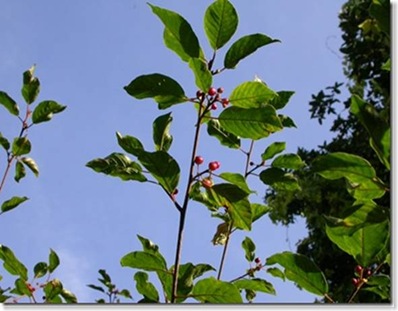
Alder buckthorn (Frangula alnus) is an unassuming shrub or small tree that is not uncommon in woods and on heaths in England and Wales. Its main claim to attention today is that it is one of the principle food plants of the brimstone butterfly (Gonepteryx rhamni) but it has had an important role in the past in the fortunes of this and other European countries through the use of its charcoal in the manufacture of gunpowder. Alder buckthorn charcoal ignites readily and burns evenly and slowly. As well as for cartridges, its steady-burning properties were exploited in manufacturing fuses for explosives (Mauskopf, 2006).

Alder buckthorn grows quite widely in my home area around the village of Sedlescombe in East Sussex, UK, mostly occurring in woodlands. I have come across a few plants, in Brede High Wood for example, that appear to have been coppiced, but I think coppice plantations of this small tree were not established locally in the past. However, as the following paragraphs will indicate, it seems highly likely that the wood was harvested as a valuable item of underwood for converting to gunpowder charcoal, either locally or further afield.

The value of alder buckthorn charcoal for gunpowder dates back many years and it has been described as being of “major military importance in the 15th to 19th centuries.” (Mobile Reference, 2010). In 1785 Major William Congreve (later Sir William) carried out tests on the charcoal from various woods and in 1791 listed alder buckthorn (as black dogwood), alder and white willow as the best types to be used in gunpowder production. Writing in 1831, Elizabeth Kent said that the charcoal made from the wood was “much prized by the manufacturers of gunpowder, who buy up all they can procure of it, and use it only for the very best gunpowder.”

Part of the reason why the economic role of alder buckthorn was obscured is that its vernacular names were confusing. John R. Jackson, curator of the museum at Kew, wrote in 1870 “In most books relating to economic botany, or to the application of woods,Cornus sanguinea, or dogwood, is referred to as yielding the best charcoal for gunpowder. Certain it is that the gunpowder makers all know the wood they use in such large quantities, by the name of dogwood, and it was generally believed that Cornus sanguinea was the plant which furnished them with their supplies.” At that period, samples of ‘dogwood’ used for gunpowder charcoal in many different places were sent to Kew and all turned out to be alder buckthorn. Jackson continued that this was proof that alder buckthorn “is the plant from whence the gunpowder-makers draw their supplies, and that Cornus sanguinea, or true dogwood, is never used, now, nor, indeed is there any proof that it ever has been, for the powder makers maintain that what they now call dogwood is the same wood which has always been used by them.”

This confusion of names has been compounded by the scientific name of alder buckthorn changing from Rhamnus frangula to Frangula alnus in the last century.

Alder buckthorn is uncommon in Scotland but, in about 1870, the Royal Botanic Gardens, Edinburgh was sent a sample of alder buckthorn (as dogwood) from the Roslin Gunpowder Mills of Hay, Merricks & Co. in Midlothian. It was “of English growth in the county of Sussex” where the price varied from £10 to £14 per ton, according to quality. The sticks, which were usually sent out in May or June, were peeled and packed into bundles of 100 (M’Nab, 1870).

The Merricks family, who established the Roslin Gunpowder Mill in about 1805, originated in East Sussex “near the gunpowder mill sites at Battle and Sedlescombe” though no evidence has been found that any of the Merricks worked at these mills (Crocker, 1996). However, it may be that they took a knowledge of alder buckthorn charcoal with them to Scotland plus a knowledge of how to procure it.

In her book about Sedlescombe, Beryl Lucy (1978) says “the charcoal for ordinary gunpowder was made from alder wood burnt in pits in the way that had been practised locally, in Petley Woods in particular, from time immemorial. For the finer or sporting powder, dogwood was used. Both of these woods are still very plentiful in our countryside. When the underwood in the district was being cut, the dogwood was carefully reserved, peeled and tied into bundles.”  Alder buckthorn is not uncommon today in the Petley Wood area of Sedlescombe, while true dogwood (Cornus sanguinea) does not occur naturally in this part of East Sussex.

Another important gunpowder mill was that of John Hall & Son at Faversham in Kent and they apparently worked in conjunction with Hay, Merricks and Co., of Roslin to produce the only explosives of the gunpowder type which successfully passed the Woolwich tests for the " Permitted List." (International Congress of Pure and Applied Chemistry, 1909).

Hall’s works at Faversham spread over six hundred acres planted with both alder and alder buckthorn “more especially of the former, for though the wood itself is not so valuable as the latter for the actual manufacture of powder, the tree is, owing to its larger size, more effectual in obstructing fragments of burning timber as well as diminishing the force of the shock in case of an explosion.” (Jackson, 1870).

As an illustration of the quality and importance of alder buckthorn charcoal, Mauskopf (2006) writes “Fine Grain powder was replaced by Enfield Rifle (E.R.) powder in 1859; the grain size of the new powder was increased from 16-36 mesh to 16-24 mesh. But the chief modification was the change of wood for the charcoal: ‘dogwood’ was substituted for alder or willow. In a footnote to this passage Mauskopf, referring to a Major Morgan of the Royal Artillery, writes “The substitute was, in fact, alder buckthorn (Rhamnus frangula), known in France as bourdaine, the traditional source of charcoal for French military powder. Since the comparative on gunpowder of the chemist J.-L. Proust, published early in the century, bourdaine was known to yield a strong powder.”

In the earlier part of the 19th century alder buckthorn was obtained chiefly from Suffolk, Norfolk, Essex and Kent (Jackson, 1870) “but after the introduction of the Enfield rifle into the military service of this country, the superior kinds of powder came much more into demand, and it was found difficult to obtain a sufficient quantity.” Because of this, supplies of the wood were imported from mainland Europe, particularly Holland, Germany and Belgium. The charcoal was prepared in enclosed iron cylinders (Saturday Magazine, 1886).

During World War I the difficulty of obtaining alder buckthorn charcoal from mainland Europe meant that supplies had to be sought within Britain. The War Office appealed for wood in Gardeners’ Chronicle in 1915 saying they “would be glad to know of any supplies of Rhamnus Frangula in this country. Estate owners who have plantations of Rhamnus and are willing to sell should communicate with the Secretary, War Office, Whitehall.” (Anon., 1915) This was followed in the same magazine a few months later by a longer article from E. M. Holmes, a pharmacist and botanist from Sevenoaks, Kent. He said, among other things (Holmes, 1915):

· The wood of this small tree is at present much wanted for the manufacture of fine gunpowder. Formerly it was imported from Germany, where apparently the tree was coppiced in order to get straight stems.

· Wood about one inch in diameter is required.

· Those who know where the tree grows in fair abundance should make known the fact.

· The wood is recognised by the manufacturer by having a reddish stain around the small pith which the wood of Cornus does not possess.

· The bark, when scratched with the finger nail or a knife blade, shows a crimson colour underneath. .

· In view of the present difficulty experience should teach the necessity of cultivating Rhamnus Frangula in woods in this country.

Charcoal from alder buckthorn remained important for munitions until the close of World War II. According to Meiggs (1949):

"The Home Timber Production Department undertook responsibility for the supply of alder buckthorn (Rhamnus frangula) needed for the manufacture of a highly specialised form of charcoal used in the making of certain types of explosive. Before the war supplies had come from France and Czechoslovakia, but in 1938 small scale orders had been placed with the Forestry Commission and had been met from the New Forest. .... It was ... plentiful enough in the New Forest for economic production and it was in the New Forest that the first war demands were met and the basis of the standard organisation laid.

The sticks were cut in 2½-foot lengths, bundled in the woods and brought to a picking up point from which they were transported to a central depot. The sticks had to be peeled, which could only be done easily while the sap was up in the spring. As the demand increased, however, production had to be maintained over the whole year; outside the natural peeling season, the sticks were first boiled in a copper for up to an hour to make peeling easier and then laid out for two or three days to dry, before being again bundled, weighed and despatched. The same organisation was repeated when new depots were opened and women made this small but important sphere their own. The operations at the depot were organised by a specially selected measurer and the peeling and other work of the depot was carried out entirely by women. Women also eventually became exclusively responsible for locating supplies in the woods and for supervising the cutting to ensure that the cutters made no mistakes in identifying the somewhat rare shrub.

The demand grew rapidly as the munition programme got into its stride. Only 50 tons had been ordered in 1939. The requirement for 1940 was 200 tons, increased in 1941 to 400 tons, and fresh areas had to be opened up. Wicken Fen was the first outside the New Forest to be exploited, and following a survey of East Anglia, operations were extended to the neighbouring counties. In 1941, since these two main sources were becoming exhausted, a complete survey was made of the country by the Cambridge School of Botany for the Biology War Committee. Much useful information was gathered in the course of this survey on the ecological habits of the plant and the areas of main concentration were tabulated. ....

With the extension of operations a new peeling depot was established in the north west, drawing supplies from the neighbouring Divisions, but by the middle of 1943 sufficient stocks had been built up to call a halt."

Despite the value and importance of its charcoal, alder buckthorn seldom seems to have been grown as a crop in Britain, most supplies being gathered from self-sown plants scattered through the underwood. Sir Joseph Hooker, director of Kew Gardens in the late 19th century, did recommend that it was grown on a coppice system and this seems to have happened in the Faversham area, but this was almost certainly the exception rather than the rule. In some places today the plant is particularly abundant, Broadwater Forest near Tunbridge Wells, for example. This area was much used by the military in the past and it may be that the tree was deliberately encouraged.

In addition to its importance for gunpowder charcoal, alder buckthorn had a role in medecine and in the production of the artist's pigment known as sap green. Kent (1831) wrote “The juice expressed from the berries being boiled down with some gum arabic and a little alum, and then poured into bladders to grow hard, is the colour called sap green.”

Alder buckthorn bark and berries have long been used as a powerful laxative. Though this largely seemed to have stopped during the 19thcentury as gentler aperients became available, the bark was used for its purgative properties during World War II. Meiggs (1949) wrote “The bark was dried on corrugated iron sheets over improvised burners and ultimately found its way into purgatives. This was no secret to the gypsies who for centuries have eaten the berries or chewed the bark of alder buckthorn in preference to the more expensive and synthetic purgatives provided by the chemist; the use of the bark for this purpose, however, only became a respectable war demand when other sources of supply were reduced.”

REFERENCES

Anon. (1915) Wood for gunpowder. Gardeners’ Chronicle, Vol 57., April 17th 1915, page 211.

Holmes, E. M. (1915) Rhamnus Frangula. Gardeners’ Chronicle, Vol 57., June 12 1915, page 332.

International Congress of Pure and Applied Chemistry (1909).The rise and progress of the British explosives industry. Whittaker & Co., London.

Jackson, John R. (1870) The “dogwoods” used in the manufacture of gunpowder. In The Student and intellectual observer of science, literature and art. Volume 4. http://goo.gl/NniVJ

Kent, Elizabeth (1831) Sylvan Sketches or a Companion to the Park and the Shrubbery with Illustrations from the Works of the Poets. Thomas Davison, London.

Lucey, B. (1978) Twenty Centuries in Sedlescombe. Regency Press, London.

Mauskopf, S. H. (2005) Chemistry in the Arsenal: State regulation and scientific methodology gunpowder in eighteenth-century England and France. In Steele, Brett D. & Dorland, Tamara. Eds.(2005) The heirs of Archimedes: science and the art of war through the Age of Enlightenment. MIT, Cambridge, Massachusetts.

Mauskopf, Seymour H. (2006) Pellets, Pebbles and Prisms: British Munitions for Larger Guns, 1860-1885. Chapter 16 in Brenda J. Buchanan (2006) Gunpowder, explosives and the state: a technological history. Ashgate Publishing, Farnham, Surrey.

Meiggs, Russell (1949) Home Timber Production. Crosby Lockwood & Son Ltd, London

M’Nab, Mr. (1870) Notes on the “dogwood” of gunpowder manufacturers. Scientific Opinion Feb 3rd 1870

Mobile Reference (2010) The Illustrated Encyclopedia Of Trees And Shrubs: An Essential Guide To Trees And Shrubs Of The World. Mobi Reference.

Friday, March 25, 2011

Lizards in the parlour

Quite unexpectedly, two full grown common lizards (Zootoca vivipara) have appeared just outside our French windows.

20110325 SV lizards Udimore map 013

We have all been watching them sunning themselves on the steps and disappearing into various cracks in the wall and behind the masonry.

They seem very tame and one of them ventured briefly over the door sill and into the sitting room.

I do wonder where they have come from.  The last lizard I saw in our garden was five or six years ago when one used to visit the Square Metre.  The new pair must have come some way to their new home and it is good to see them.  If male and female, let's hope them have a family.

Thursday, March 10, 2011

Hazel catkin galls

Now, with the weather improving, is the time to walk out and look for galls on hazel buds and catkins.

In my garden and round about, practically every hazel bush has big bud galls made by the mite Phytoptus avellanae.

20110309 SV Phytoptus avellanae 1

A more detailed search quickly revealed some galled catkins.

20110309 Contarinia coryli on hazel 016

The unopened brown catkin on the right has been attacked by either the mite Phyllocoptes coryli or the Cecidomyid midge Contarinia coryli.  The only way one can tell which species is responsible is by picking them apart and looking for the mites, which are minute, or the small white grubs of the midge.  I quite quickly found midge larvae - little white maggots - but have not found any of the mites yet.  They are very small though and will need a microscope.

Galls like this (the only two found on hazel catkins in Britain) are probably common throughout Britain, but rarely recorded, so if you come across any, don't forget to send records in.

The nut bud moth (Epinotia tenerana) also lives, in its earlier instars, in hazel catkins before boring its way into hazel buds to complete its development.  It is also widespread in Britain, so that' another one to look out for.

Thursday, January 27, 2011

England's forests for sale

The much broadcast government consultation on the proposed sale of large parts of the estate owned by the public via the Forestry Commission was launched today:

http://www.defra.gov.uk/corporate/consult/forests/index.htm

Apart from saying, in the style of Sellar & Yeatman "This is a bad thing" (which I believe profoundly that it is), I thought I might use this space to set out some considerations that I have not seen covered in the media, but are important.

This is just a start. I will update this entry as time goes by.

30 January 2010

There is a very well considered commentary on the proposed forest sell-off from the Chief Executive of the Sussex Wildlife Trust, Tony Whitbread, here: http://www.sussexwt.org.uk/blog/2011/01/forestry-commission-sell-off/

27 January 2010

Access. The Government says that access will be conserved. Does this mean that new owners will be under an obligation to maintain car parks and footpaths and, in particular, any open glades or heathy areas that are so important for biodiversity? Will rides have to be maintained at an appropriate width for optimum ecological benefit? Will there be 'close seasons' when shooting takes place, or the birds to be shot are breeding? Will 'access' mean the freedom to go anywhere in the wood or forest, or will it be confined to set paths and routes?

Identification. How will we know if a wood or forest has public access or not? Currently Forestry Commission Woods are clearly marked on the popular Ordnance Survey Explorer and Pathfinder maps. If these woods are sold and the Forestry Commission marking removed, how will people know which woods are accessible? Perhaps the Government could consider continuing to mark them on maps some how or other. "Former public wood sold to a private owner by the Coalition Government in 2011."

If all the Ordnance Survey and other Government maps have to be changed, I wonder if the cost has been taken into account.

Many Forestry Commission properties have a sign at the entrance(s) so that people know there is access. Will the new owners have to erect signs saying that the wood/forest is one of the free access ones?

Is there the quite interesting danger that, in the absence of any positive information, people will assume that most or all woods have access? If challenged when walking, could the appropriate response be "Oh, I thought this was one of the public woods you had bought from the Government."

Is this a good moment to press for the 'Right to Roam' to be extended to woods and forests?

Shooting. I mentioned shooting above and, unless shooting is absolutely forbidden in any sold off woods/forests, it seems likely to escalate. Apart from the dislike of this pursuit by so many who use the countryside, it is likely to represent both a danger and a reason to deny access to woods. Many who have been in France know the tyranny in the French countryside of 'La Chasse' and its powerful lobby.

There is also the question of noise. The countryside where I live has been relatively peaceful for the last several years, but this could change with the dismal sound of organised shot gun fire reverberating around during the shooting season. This unpleasant effect extends, of course, far beyond the woods and forests where it is taking place.

Management. There has been much talk of management. It may be possible for an experienced woodland/forest manager to be employed on the larger properties. Most of the smaller ones are too small to justify such an expense. Organisations like county wildlife trusts, the RSPB or the Woodland Trust have managers that cover a number, often a large number, of woodland properties spread over a wide area. The input of experienced people from the Forestry Commission who cover large areas will, presumably, no longer be available and the management of small woods will suffer as the new owners are unlikely to have the time or money to invest in the long learning curve and multiple skills needed to know how best to deal with a wood.

Countryside stewardship. If the scheme continues, many of the sold off woods could be eligible for Entry Level or Higher Level Stewardship. Among other things this means they will receive payment from the Government provided they stick to the agreed management plan. I wonder if the cost of this has been taken into account in considering the 'profit' from woodland/forest sales.

Deer control. In many places deer, and also wild boar, are increasing. Their control via fencing and culling are complicated operations requiring cooperation over large areas if they are to be effective. Many of the animals are using smaller woods and increasingly coming into gardens as different, and often only partially successful, strategies are used to control them. If they are not controlled (and some new woodland owners might not want to) some woods may, in the long run, turn into wood pasture and, ultimately overgrazed grassland with starving animals and not much else.

Wednesday, August 04, 2010

Robber flies and hogweed larvae

Today as I was watering my house leeks a kite-tailed robber fly (Machimus atricapillus) landed on our abandoned refrigerator (circa 1935) and enjoyed sucking the juices via the head of a hapless hoverfly it had just caught.

20100804 Wbx & South View 030

Not far away I found some caterpillars of the fuscous brindled flat-body moth, Depressaria pastinacella, a common species but one that normally remains closely concealed in a spun together head of hogweed.

20100804 Wbx & South View 008

Monday, August 02, 2010

The weasel's lunch

Today I decided to have my lunch looking out into the garden.  Suddenly a weasel emerged from the undergrowth only a couple of metres from me and crossed our small patio.  She held her head high as she was carrying a dead mouse, as cats carry a kitten,  in her mouth.

We do occasionally see weasels in the garden, going along the hedge bottom or elsewhere, but I have not noticed one for several years past and think, like many creatures, they must be getting rarer.

Maybe the mouse was her lunch, but as she was carrying it elsewhere, I like to hope she has a family somewhere in our garden.

Wednesday, July 28, 2010

A bank full of betony

Just below the south of the junction of Compasses Lane and the B2244 Hawkhurst Road on the western bank at TQ7763820510 is a magnificent stand of betony (Betonica officinalis formerly Stachys officinalis). Their rich purple flowers make a landscape feature and the small white-flowered umbellifer pepper saxifrage (Silaum silaus) also grows here, indicating this is long undisturbed grassland.

20100727 BHW & Killingan 031

Betony was much used by herbalists in the past and in the Domestic Encyclopaedia of 1803 it says that, among other things it "affects those who gather any quantity of its leaves, with a disorder resembling the effects of intoxication."

Betony garlands worn round the neck were said to suppress nightmares and the Anglo-Saxon Herbal said it would protect against"frightful goblins that go by night and terrible sights and dreams."  If one put an adder within a garland of betony it was said that it would kill itself, while thrusting a leaf up one's nose was regarded as a cure for toothache (Medicina Britannica, 1748).

The now rare great case moth (Coleophora wockeella) feeds only on betony and, as the name suggests, goes about like a hermit crab or caddis larva in a small (not great) case made of bits of the leaves.  There is a picture here: http://ukmoths.org.uk/show.php?bf=527

Tuesday, July 27, 2010

Killingan Coppice again

The fruit are already ripe on the bittersweet (Solanum dulcamara) and here it looks as though the sloe bug (Dolycoris baccarum) centre right is enjoying some of the juice while standing on its head.

20100727 Killingan bittersweet & sloe bug

The plant is toxic to humans and, although quite large quantities have to be eaten before there are any serious effects, it is important not to experiment.  Sloe bugs appear not to be affected.  The stems are said to be sweet when first chewed, but quickly turn bitter hence, I assume, the name dulcamara meaning sweetbitter.

Spear thistles (Cirsium vulgare) are in full bloom now and very attractive to bumble bees.

 20100727 BHW & Killingan 016

Another plant doing exceptionally well along the coppice edge in response to higher light levels is upright hedge-parsley (Torilis japonica).

20100727 Killingan Torilis japonica

In Korea seeds of this species are one of the ingredients in the 18 herb concoction called paeng-jo-yeon-nyeon-baek-ja-in-hwan (PJBH for short).  In Oriental medicine PJBH is reckoned to activate brain function, promote memory and lengthen life span.  Might try some if I can find the other 17 ingredients.

Thursday, July 15, 2010

Why 'black' bryony?

With is shiny green leaves and bright red berries, black bryony (Tamus communis or sometimes Dioscorea communis) is anything but black.

However, it does have a tuber (which was used in medicine) with a black exterior and the leaves, like those shown below, sometimes turn purplish black in summer and autumn.

20100715 Tamus communis black leaves 004

The name also helps to differentiate the species from the unrelated white bryony (Bryonia dioica), the mandrake, also much used in medicine.

Both plants are climbers with red berries.  This is white bryony at Pagham Harbour, where it tends to sprawl.

20090812 Pagham 019

Saturday, June 26, 2010

Fallen elders

Along the garden path there is a place where an old, dead elder tree (Sambucus nigra) has fallen across a smaller, living example of the same species.

20100626 South View fallen elders  011

Together they make an attractive architectural and wildlife feature.  The dead tree has plenty of ear fungi on its upper branches and elsewhere and the smaller, living example has ivy ascending the trunk which holds up its dead sister.  It has a few flowers (centre left) but is also sending up some strong shoots for the future.

A good place to sit and meditate on life and death and an interesting little wilderness to try and mould into a semi-designed feature.

Thursday, June 24, 2010

The Year of the Welsh Chafer

There have recently been reports from many parts of England of unusually large numbers of the Welsh chafer beetle, Hoplia philanthus, emerging in semi-improved grasslands and often flying in swarms over meadows.

20100623 Ashburnham & South View 028

The adult beetles, as above, are reddish coloured, or black and present a very dark appearance in flight.  Walking in the meadows at Ashburnham, East Sussex a few days ago we were surrounded by maybe 100 or more of them flying like small bumble bees and with a similar buzzing sound.  To a non-entomologist this would have been quite a threatening experience, though the beetles are harmless and none actually settled on us.

20100623 Ashburnham & South View 004

The reason why the species is called the 'Welsh chafer' I have not yet been able to establish, but I think it is likely to be quite an old name.  The insect seems to be no commoner in Wales than elsewhere.  In Dorset its local name is the 'apple eater' (Dale, 1878), though the larvae live in turf, eating grass and other roots.  Maybe they come up sometimes for orchard windfalls.

Dale, C. W. (1978)  The history of Glanville's Wooton in the county of Dorset.  Hatchards, London

Anyway, if anyone knows the reason for the name Welsh chafer, I would be grateful to hear from them.

Tuesday, June 15, 2010

Coppice developing

The part of Killingan wood that was coppiced less than 18 months ago is already rapidly scrubbing over with brambles.  There is less and less bare earth and moss left and smaller plants are rapidly being suppressed.  This is not quite what coppice is supposed to do: if violet-feeding fritillary caterpillars were to flourish, for example, the ground would have to remain open for far longer.

20100614 Killingan Wood coppice 034

It is interesting to speculate whether this used to happen in the past or in different types of coppice rotation.  In terms of forestry it seems to me that the brambles are quite important as they give some protection to the new shoots rising from the tree stools.

The flora continues to provide interest and I some of the most striking are shown below:

20100614 Killingan bittersweet 027

Bittersweet or woody nightshade (Solanum dulcamara)

20100614 Killingan foxgloves 029

Wild foxgloves (Digitalis purpurea) among the brambles.

20100614 Killingan foxgloves 030

And some cultivar foxgloves at the woodland edge that must have escaped from a garden.

20100614 Killingan marsh thistle 024

Marsh thistle (Cirsium palustre), what the gardeners call an 'architectural plant'.

20100614 Killingan Veronica officinalis 033

Heath speedwell (Veronica officinalis), a low-growing plant of poor, dry soils.

20100614 Killingan ox-eye daisies 023

And ox-eye daisy or marguerite (Leucanthemum vulgare), a plant of meadows and waysides, but quite happy here at the woodland edge.

20100614 Killingan ox-eye daisies 028

Thursday, May 06, 2010

Yellow archangel: more than meets the eye (or nose).

Yellow archangel (Lamiastrum galeobdolon) is an attractive dead nettle particularly associated here in South East England with ancient woodland.

20100504 Archangel Killingan coppice 010

It has done very well indeed this year in the area of coppice just up the road and makes a wonderful contrast to the bluebells.

It did not, however, seem a very exciting plant - few insect associates, few medicinal properties and, like many plants that are not actually poisonous, said to be edible when young.

The specific name is also not very inspiring as it is supposed to indicate that the plant smells like a weasel or marten and some claim that weasels smell worse than skunks.

However, after a few minutes research I discovered that yellow archangel is used as a garnish by the celebrated Danish chef René Redzepi, of the Copenhagen restaurant Noma, winner of this year's Restaurant of the Year Award.  See here for some of his recipes:

http://www.caterersearch.com/Articles/2009/05/15/327635/rising-star-ren-redzepi-shows-off-some-noma-recipes.htm

Apparently Redzepi sprinkles raw flowers and shoot tips of yellow archangel over a dish of baked celeriac and black pudding also garnished, of course, with salted ramsons seeds pickled in vinegar.  I am sure that the mustelid aroma would add greatly to the quality of this dish.

My family is in for a gastronomic treat this weekend.

20100504 Archangel Killingan coppice 009

Since penning the above I have, in the interests of both science and gastronomy, sampled leaves and flowers of yellow archangel.  I am happy to report that I could detect no unpleasant aroma and the taste was leafy and slightly nutty - a bit coarse, but not disagreeable.

So, maybe galeobdolon (a name coined by ancient Greek physician Dioscorides) has nothing to do with the smell of weasel unless it was used mischievously to deter people from collecting the plant for the kitchen.  Alternatively the word may have something to do with galea the Latin (and ? Greek) for a helmet from the shape of the flowers.  And anyway, perhaps Dioscorides didn't mean yellow archangel as we know it.

Wednesday, May 05, 2010

Baby orange-tip

In Killingan coppice today I started to look for orange-tip butterfly eggs on the stand of lady's smock (Cardamine pratensis). 

20100425 Cardamine pratensis Lady's smock Killingan coppice 046

It was almost too easy.  On the first plant I looked at there was a solitary characteristically shaped orange egg carefully placed beneath a flower stalk (see picture below near centre).  They are usually put on their own like as though the mother knows that her caterpillars will have strong cannibalistic tendencies .

 20100504 Orange-tip egg Killingan coppice 007

With a good deal of luck this will have turned into a butterfly by next May.  Below is a female of the species.

20080519 Brede High Woods 10a Rafters Wood orange-tip female 063

Monday, May 03, 2010

White on grey

Today, Bank Holiday Monday, was showery and cold.  Great dark clouds rose up to the east of our garden showing off to perfection the flowers on the wild cherry (Prunus avium).  As Housman wrote "Loveliest of trees, the cherry now/is hung with bloom along the bough,"

20100503 Prunus avium South View 5

Cherry trees are the subject of a 3-year survey being organised by the Natural History Museum, though they are largely interested in garden cherries as part of a general interest in the significance of gardens for biodiversity.   See here: http://www.nhm.ac.uk/nature-online/british-natural-history/tree-survey/index.html

20100503 Sorbus aria leafing South View

Also foregrounded by the clouds and sunshine were the opening leaf buds of whitebeam (Sorbus aria).

Thursday, April 29, 2010

Return of the goldilocks buttercup

 20100429 Killingan R auricomus 002

Goldilocks buttercup (Ranunculus auricomus) used to be common in our High Weald woodlands when I was a boy, but it seems to have become scarcer and scarcer over the years.

There used to be a small colony in the wood at the top of our lane but I thought this had gone.  Today though I was very pleased to find about half a dozen plants in full bloom beside the path.  Although the abundant celandines (Ranunculus ficaria) with their rather similar yellow flowers can make the goldilocks buttercup easy to walk past, it has an attractive, airy quality with delicate stems with their narrow upper leaves holding up the shining yellow flowers.

20100429 Killingan R auricomus 004

Many of the flowers do not have full compliment of petals, or have one or two normal petals plus a few abortive ones and I wonder if this is related to their asexual reproduction

Goldilocks buttercup can reproduce asexually and several hundred microspecies (also called 'agamospecies') have been described from mainland Europe.  Apparently there may be a similar number of these microspecies yet to be described in Britain.

If the plants can reproduce without pollination there would seem to be no need to attract insects making petals redundant.  However, asexual reproduction implies little or no variation so, presumably, the number and type of petals would remain the same down the generations and not 'evolve' into plants with petal-free flowers.

Thursday, April 22, 2010

Variegated honesty returns

One of my favourite garden plants is the variegated form of honesty, Lunaria annua, an introduced species whose origin is unknown, though the perennial subspecies is found in Italy and the Balkans.  It has been grown in Britain since at least 1570.

20100421 SV honesty 017

The plain green form is attractive, but this version with cream edging to the leaves is quite spectacular as it rises into flower in spring.  There is also a white flowered variegated form.

Despite its scientific name, this plant is a biennial here: seed sown later this year will flower next year.  The seedlings are markedly variegated when they appear but quickly turn wholly green.  The variegation reappears as the plant develops towards flowering at the end of winter.  Then, of course, there is the later benefit of the silvery, penny sized seed pods.  The fact that these seeds can be seen through the thin walls of the pods is the reason for the name 'honesty'.

The leaves and roots are said to be edible and the ground seeds have been used as an alternative to mustard.  The scented flowers are attractive to insects and orange-tip butterflies will sometimes lay their eggs on the plant and, so far as I know, the caterpillars flourish on it just as much as on cuckooflower, Cardamine pratensis, their usual pabulum.

We used to have quite a number of self-sown plants in the garden every year and I thought I had lost them way back in the last century, so I was very pleased when this one appeared.  It is in an area where there was much deep shade under a Lawson's cypress removed last summer.  Clearly the advent of light and warmth has triggered a long dormant seed.

Wednesday, April 14, 2010

Less usual spring flowers

Spring is still running late, though the day before yesterday I saw the first blue on some bluebell buds.

Two of the rather less common spring flowers are the marsh marigold (Caltha palustris) and the wood dog-violet (Viola reichenbachiana).

20100413 Swallotail Hill Farm 001

Marsh marigolds seemed much commoner when I was a child and I know only a few places locally where they still grow.  Their preferred habitat is very wet meadows and most have these have been drained.  Even when they are re-flooded, the Caltha does not seem to return.

20100413 Viola reichenbachiana

The violet is holding its own rather better, especially in well-lit areas of clay woodland.  It flowers slightly earlier than common dog-violet (Viola riviniana) which grows in similar places and the violet shade of the narrow flowers has rather more red in it than riviniana.

The scientific name of the violet pays homage to Ludwig Reichenbach, a 19th century German botanist.

Saturday, April 10, 2010

A new toy

I have acquired a new toy in the shape of a digital microscope wired up to the computer.

It takes a bit of getting used to, but hopefully it will enable me to share some of the smaller creatures I come across with you.

As well as scanning over things, it is easy to capture a still, or even a video, and this can then be tidied up and kept on the computer.

My first effort (and I am sure quality will improve) was of the coffin fly Megaselia ciliaris (Diptera: Phoridae).

Megaselia ciliaris

Only about 2mm long, I found several in one of my traps over a stack of decaying logs in the garden.  Megaselia is a huge genus and identification is often difficult as the flies normally have to be mounted on a microscope slide like this one and often dissected to see some of the smaller features.

One of the distinctive features of this species is the partially yellow front legs.

Tuesday, April 06, 2010

Tortoiseshells return

After some years of very low numbers, the small tortoiseshell butterfly (Aglais urticae) seems to be back in numbers.  Today I saw several, including the one below, in a rough field at Netherfield in East Sussex wheeling about and buzzing one another in the warm afternoon sunshine.

20100406 Darvel Down Netherfield 016

This recent decline has been linked to the parasitoid tachinid fly Sturmia bella which was first recorded in Britain in 1998 at about the time the decline of the small tortoiseshell began.  The butterfly caterpillars swallow the eggs of the fly while they are feeding and the parasitoid larvae develop inside them, eventually killing them.

Some research has been done on this and large numbers of small tortoiseshells have undoubtedly been attacked by Sturmia, but results are not so far conclusive.

It may be that we will now see cycles of abundance and scarcity of this species (as with the holly blue and its parasitoid).  More butterflies means more tachinids, but this leads to less butterflies and less tachinids and so on round and round