Sunday, March 22, 2009

Sweet violets

On the verge of the road called Gorselands in our village of Sedlescombe there is an astonishing colony of sweet violets (Viola odorata) with pale and dark colour forms. 

20090321 Viola odorata Sedlescombe 004

This is not a native of our area and I suspect the original plants were imported with turf, probably from the South Downs, used to make the verge.

We also get small colonies of V. odorata var. praecox which is I think always a garden escape here.  It flowers earlier than the nominate subspecies and has smaller, darker flowers.  Both types, of course, have that wonderful scent.

20080209 Viola odorata 001

Tuesday, March 17, 2009

Breeding blackbirds (Turdus merula)

Our garden blackbirds are nesting now and I often see the female collecting bits of stick and grass for the nest.  The male tends to sit up in the bushes like this just keeping an eye on things.

20090317 Blackbird South View 011

There is nearly always a pair of blackbirds active around the house and it is easy to think they are the same ones every year but, in the 35 years we have been here, there must have been many generations - sic transit gloria mundi.

Blackbirds usually stay in or near the same place all the year round but some go on longer haul journeys.  One famous bird travelled regularly some 228 miles from Norfolk to South Devon for the winter.  See: http://news.bbc.co.uk/1/hi/england/4353671.stm

Wednesday, March 11, 2009

From the cormorant's nest

I was recently presented with an old and large cormorant's nest from the Rye Harbour Nature Reserve.

Consisting of a large bundle of sticks decorated with a few strands of flotsam and carrying a rich complement of fish waste, guano and dead chicks, it came in a dustbin but has now been transferred to an Owen emergence trap.

20090311 South View 002

So far two insect species have emerged, both in some numbers.  One is the common overwintering greenbottle, Eudasyphora cyanella, and the other Siphunculina aenea, a tiny, rarely recorded red data book gout fly (Chloropidae) - see below. 

20090302 Cormorant - Siphunculina aenea

This species has been bred from bear's dung in the Orient, so it sounds as though it is not too fussy, though there has to be some reason why it is rare.

Monday, March 09, 2009

Landscape with slime mould

The scene below is a close up taken yesterday showing the fruiting bodies of a myxomycete, or slime mould, growing on the bark of a dead spinning gum (Eucalyptus perriniana) in our garden here in Sedlescombe, East Sussex.

20090308 Metre & South View 017

It was originally a vertical picture (that is with the fruiting bodies sticking out sideways) which I have turned to horizontal.

I thought it looked remarkably like some African savanna dotted with bushy-topped trees.

Saturday, March 07, 2009

Holly microfungus

Scrambling along the south eastern gill in Yellowcoat Wood, near Flimwell, East Sussex (grid ref TQ 713303) this afternoon, I found some small, rusty brown objects erupting the the bark on the trunk of an old holly (Ilex aquifolium).

20090307 Nectria punicea var ilicis Flimwell 09

They were easily identifiable as Nectria punicea var. ilicis, a species for which I can find no other East Sussex records, though I suspect it is not uncommon.

Yellowcoat wood is, by the way, the reputed site of a medieval massacre.  In 1264 King Henry III on his way to the Battle of Lewes is said to have had 300 local archers beheaded there (it was then a field) in response to one of his retinue having been killed.

Monday, March 02, 2009

The two moths mystery

A few days ago I found, in the morning, a twin-spotted quaker moth (Orthosia munda) at rest on the white enamel front round the top of our kitchen cooker.

20090227 South View & Metre 020

It had certainly not been there the previous evening and as no windows were open or lights on during the intervening period, I wondered how it had got in.

Orthosia species often play dead when disturbed and this makes them quite easy to photograph on any convenient bit of wood (as in the picture above).

This morning, to my surprise, I found a closely  related moth, the Hebrew character (Orthosia gothica) in almost exactly the 20090302 BHW & Metre 052same place: on the white enamel at the top of our kitchen cooker. 

Apart from the strangeness of their being there, I am surprised that they both decided to settle on a shiny white surface rather than on the numerous wooden surfaces about the house where they would be much better camouflaged.

Both moth species are common early flying creatures that come readily to light and to sallow blossom.

Saturday, February 28, 2009

Snowdrop time

Every year I feel obliged to photograph snowdrops (Galanthus nivalis), I suppose because they are among the very first flowers of the new season and have a chilly, but cheerful, elegance.

20090228a Snowdrops 107

They are not thought to be a native species in the British Isles and they rarely seem to grow far away from houses, roadsides or streamsides here in East Sussex.  The first record in the wild was not until 1778, but they were known in cultivation well before that.

It has been suggested that snowdrops were the source of the magical herb called 'moly' used by Odysseus to protect him against Circe's spells and there is much of the usual folklore associated with well-known plants.

Once the flowers have faded they leaves follow quite quickly and I find it quite poignant that when spring is really getting going the snowdrop is retiring from the world for another season.

Friday, February 20, 2009

The magic pool

Yesterday we made a visit to nearby Bodiam Castle.  There has been much rain lately and a large pool of water remained in the field between the car park and the castle grounds.  This produces some interesting reflections.

I took this picture looking north with the pool in the foreground:

20090219 Bodiam 050

A few moment later, from the other side of the pool I took this picture looking south across the Rother valley:

20090219 Bodiam 056

Same stretch of water, but a different reflection.  It all depends, as they say, on your point of view.

Tuesday, February 03, 2009

Sun on snow

On an afternoon walk in a snowy landscape on a grey afternoon, the sun suddenly broke through the clouds and illuminated a distant field.

20090203 Sedlescombe snow field 008

Thursday, January 22, 2009

The frost is all over

In my ramblings about East Sussex after the recent hard frosts I have noticed that many larger ivy leaves have turned a buttery yellow as though the plant was variegated.

20090117 Stonelink frosted ivy

It reminded me of the well-known Irish jig The frost is all over and I found a splendid meditation on this in words and music here.

Monday, January 19, 2009

Hairstreaking in the Brede Valley

On Saturday, at the invitation of Butterfly Conservation's Rother Woods project, we went looking for brown hairstreak butterfly (Thecla betulae) eggs in the Lower Brede Valley, East Sussex.  The species has been occasionally recorded in this area in the past and it may simply have been overlooked as it is a difficult butterfly to find as an adult.

Neil Hulme from Butterfly Conservation (Sussex) joined the group and brought an egg on a blackthorn twig so that we all knew what to look for (see picture below).  The egg came from West Sussex and was scheduled to be returned, on its twig, after our field meeting.

20090117 Neal Hulme at Stonelink 010

20090117 Stonelink 004

The eggs are usually laid in the fork of a blackthorn twig as above and look like small, hemispherical pearls.  They remain in situ until the leaves come in spring and, once seen, are fairly easy to find if they are present at all.  There are one or two eggs of moths that can be laid in this position, but they are not of this shape.

We had a good walk round the hedges at Stonelink but did not find any eggs (early days yet) though we did see some impressive wild boar rootings and found a strong colony of the rather scarce hard shield-fern.

20090117 Stonelink 017

Tuesday, January 13, 2009

Brimstone moth caterpillar

At the end of our garden I have an open-ended hanging sleeve trap over an artificial water-filled tree hole.  Today, after about a week of hard frosts, I was surprised to find a small brimstone moth caterpillar inside the trap.

20090113 Opisthograptis luteolata 030

The brimstone moth (Opisthograptis luteolata) is a common species with several generations a year and often there are overwintering larvae, though it is difficult to see what they eat if they are very active like this one.  Normally they feed on the leaves of deciduous shrubs like hawthorn and blackthorn.

Mine keeps casting round the box and the various leaves I have provided, but does not seem to be eating any of them.  Maybe I will just let it go again rather than breed it through.

The caterpillars do, of course, look very much like thorn twigs, though in some areas they are green rather than brown.  The explanation for this dimorphism does not seem to be known, but it is not uncommon in the caterpillar world.

Wednesday, January 07, 2009

Coppicing for butterflies

As part of the Rother Woods Project, sponsored by Butterfly Conservation and others, coppicing has started in Killingan Wood about 200 metres north of our house.
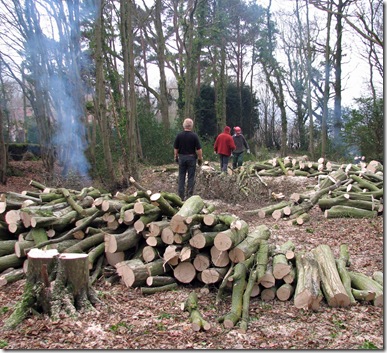
20090107 Killingan Wood coppicing 001a

Most of the wood is very shady since coppicing ceased many years ago and the trees, mostly hornbeam, are now what coppicers call "overstood", that is they have gone far beyond the ideal age for cutting.

The increase in sunlight reaching the ground will certainly have a beneficial effect on early-flowering woodland plants and there may also be an increase in woodland butterflies and some other invertebrates.  Most of the stools should, however, grow up again quite quickly (if the deer do not get at the new shoots) and shade will rapidly return to the woodland floor.  Hopefully there will be plenty more areas of new coppice to which the light demanding species can move.

20090107 Killingan Wood coppicing 009a

The notice above on a tree where the path starts into the wood says the timber will be used for firewood.  This is now getting to be quite a scarce resource in South East England but it was, of course, what many of the coppices were used for in the past.  In a more natural world than our own, unless there were forest fires, trunks and branches of trees would die and fall to be colonised by a myriad of fungi and invertebrates and these, of course, would provide important food resources for birds, bats and other wildlife.  But we can't have everything and, if gas fails to arrive from Russia, I am sure many will be grateful for the short period of respite British fuel wood might be able to provide.

Anyway, being so close at hand, I will have a splendid opportunity to observe exactly what happens after this coppice restoration.

Sunday, December 21, 2008

The lake at Woods Mill

I regularly visit the Sussex Wildlife Trust's reserve at their Wood's Mill headquarters near Henfield in West Sussex.  There are many pools, streams and a river here and the photograph shows the largest lake in its sombre midwinter persona.

20081221 Wbx & Mtre 004

The reserve is rich in wildlife and has, of course, been studied in detail by the staff and the many visitors with their comprehensive knowledge of Sussex wildlife.  Whether one knows anything about wildlife or not, it is a very peaceful and beautiful place, accessible to all.

Tuesday, December 09, 2008

Charcoal smoke

On cold mornings in the upper Brede Valley smoke from the charcoal burning kilns in Marley Lane rises in the stillness and spreads out in a thin layer over the denser portion of air that has filled the valley bottom where the frost lies.

20081205 Churchland fields smoke 003a

This is a traditional industry probably done in the same place for hundreds of  years.  It stopped for a while a few years ago, but has now started again and the smoke is back.  The farthest ridge in the picture is where the Battle of Hastings was fought, Normans on the left, Anglo-Saxons on the right.

Saturday, November 15, 2008

Parasol mushrooms

Today I spotted several parasol mushrooms (Macrolepiota procera) on the verge of the lane to the village.  They often appear here and have formed quite a large colony over the years.  Mid-November seems very much later that usual though.

20081115 KWR & Parasol mushrooms 007

I brought three youngish ones home and we had some excellent parasol fritters.  If fried, or used in other recipes for mushrooms, parasols tend to grow rather soft and watery, so fritters is a good way of using them - a crisp, slightly spicy outside with a soft, fungus-fragrant interior.  The sort of food that is almost impossible for a restaurant due to the fragility of the parasols and the irregularity of their appearance.

I just remove the stalk and cup the cap into eight wedges.  These are then dredged with plain flour, dipped in batter and deep fried in fat somewhat less hot fat than for potato chips.  In the picture of the fritters below, I am amused by the little mushroom-like protuberances made by batter trying to escape.

20081115 KWR & Parasol mushrooms 009

Some care has to be taken over consuming parasol mushrooms as they have several decidedly poisonous lookalikes, though this is more of a problem in mainland Europe and North America than in the UK.  Also some people may have an allergic reaction, so try a very small amount first if you are tempted.

Wednesday, November 12, 2008

Elder in service

I found a young elder tree (Sambucus nigra) today growing in the fork of the trunk of the wild service tree (Sorbus torminalis) just outside our house.

20081112 Service and elder at South View 004

The elder has found sufficient nourishment and water trapped in the trifurcation of the trunk to grow well in it its first season and it may persist for some years.

The fork in the wild service is at chest height and came into being when the single stem of the young tree (which I grew from seed sown about 1974) was toppled by a bright blue weevil called Rhynchites caerulea.  These cut right round the young green shoot which topples over and usually falls to the ground.  The adult weevils lay their eggs in these fallen shoots which subsequently feed their larvae.

The following year two or three stems arise from the damaged maiden in the absence of a leading bud and this creates the fork.  As leaves and water, not to mention baby elders, gather in the fork it makes a weak point from which decay can easily get into the centre of the trunk and ultimately bring about the death of the tree.

So it goes (as Kurt Vonnegut would say).

Monday, November 03, 2008

A new Brede High Woods weblog

The purchase of most of Brede High Woods lying between Sedlescombe and Brede in East Sussex was completed by the Woodland Trust last December and there continues to be full public access to these wonderful woodlands and other habitats.

20080519 Brede High Woods 5b 012

I live within easy walking distance of the woods and have been exploring them since the late 1950s, so I am very pleased that they have been secured for everyone to enjoy in perpetuity. As well as ancient woodland, the area has unimproved grassland, heath, sphagnum bog and a variety of streams and ponds, all of which goes to ensure a rich and important biodiversity.

I have worked closely with the Trust over the last couple of years and have now started a Brede High Woods weblog to alert as many people as possible to the delights of the place.

[Brede High Woods weblog]

Tuesday, October 07, 2008

Ferry Pool, Pagham, West Sussex

At this time of year the purple glasswort (Salicornia ramosissima) is a landscape feature on the salty mud of Ferry Pool opposite the Pagham Harbour reserve visitor centre (SZ 8558 9657).

20081006 Pagham Ferry Pool 001

Migrant hawker dragonflies (Aeshna mixta) were still on the wing and the female below was observed laying eggs in the bases of the reed stalks in the dykes where the water is much less salty.

20081006 Pagham Ferry Pool 004

Sunday, September 21, 2008

Mini meadow browns (Maniola jurtina)

On a walk near Staplecross, East Sussex yesterday I noticed two small mating butterflies.  At first I thought they might be hairstreaks, then gatekeepers, but the photo below indicated that they were meadow browns, but almost half the normal size. 20080920 Wellhead Woods, Meadow browns

The one on the right is pale because its wings are tilted towards the sun.

This butterfly is normally common in our area from June to mid-August and this is the latest I have seen them, though they are known to occur as adults as late as October.

These late emergences are said to occur more frequently where there is short (and therefore warm) turf on the Downs and in similar places and several authors have noted that these late-flying butterflies are often smaller.

Apparently this species only has one generation a year, so these cannot be the offspring of earlier-flying adults.

It is curious though that both butterflies in the picture are of a similar small size and must have emerged at broadly the same time and one wonders why the idea of their being a second generation has not been considered.